







.avif)






.avif)

-(1).avif)







.avif)

How Cold Formed Steel Framing Improves Residential Construction
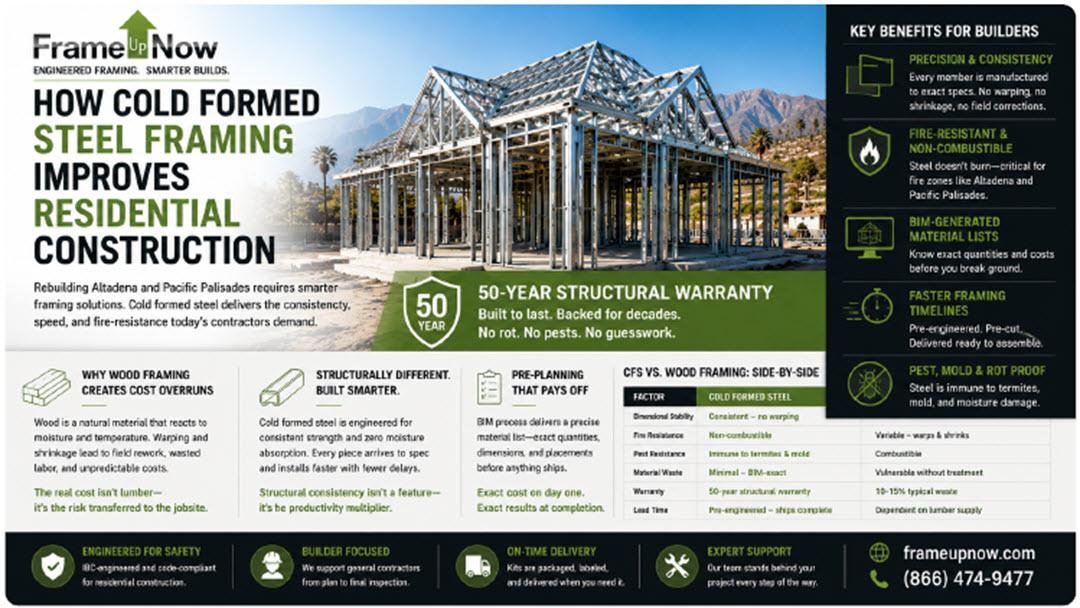
After the 2025 Altadena and Pacific Palisades wildfires destroyed thousands of homes, general contractors across Southern California are facing a rebuild environment where speed, material accuracy, and fire-resistant construction are no longer optional — they are the baseline. The question isn't whether to build smarter. It's whether your framing system can keep up with the demand.
Residential steel framing is the use of cold-formed steel (CFS) members — manufactured to precise dimensional tolerances — as the structural skeleton of a home. Unlike wood, CFS does not warp, shrink, or burn. For general contractors managing multiple rebuild projects in fire-affected communities like Altadena and Pacific Palisades, it delivers structural consistency, predictable material quantities, and faster framing timelines that wood simply cannot match at scale.
Key Takeaways
Cold-formed steel framing eliminates dimensional variability — every member arrives at spec, reducing field corrections and framing delays
CFS is non-combustible, making it a structurally sound choice for fire-zone rebuilds in Altadena and Pacific Palisades
BIM-generated material lists allow general contractors to know exact costs and quantities before breaking ground
Steel framing is not a fit for every project — budget, crew familiarity, and connection detailing require honest evaluation
IBC-engineered steel frames carry a 50-year structural warranty, reducing long-term liability exposure for contractors
Why Does Wood Framing Keep Producing Cost Overruns on Residential Projects?
The surface answer is lumber price volatility. The real answer is dimensional inconsistency.
Wood is a biological material. It responds to moisture, temperature, and storage conditions. A 2x6 delivered to a jobsite in January is not the same 2x6 that gets framed in March. Crowning, warping, and shrinkage force field corrections that consume labor hours no estimate accounts for. Those corrections compound across a full framing package.
The real cost of wood framing isn't the lumber price — it's the labor absorbed by material unpredictability.
This is the root cause most estimators miss. They price lumber accurately and still blow the framing budget because they're not pricing the rework that dimensional variance creates. In high-volumere build environments — exactly what Southern California general contractors are managing righ tnow — that variance multiplies across every unit.
> The problem with wood framing isn't that it's old technology. It's that it transfers material risk to the jobsite, where it costs the most to resolve.
What Makes Cold-Formed Steel Structurally Different From Wood?
Cold-formed steel framing is manufactured by rolling steel sheet stock into structural profiles atambient temperature — no heat required. The result is a member with consistent cross-section, predictable load capacity, and zero moisture absorption.
Every stud, track, and header arrives dimensionally identical to the engineering spec. There is no field sorting. No rejection pile. No substitution calls to the supplier.
For general contractors running parallel rebuild projects in Altadena or Pacific Palisades, this matters operationally. When framing crews can trust that every piece is what the drawing says it is, installation moves faster. Fewer field decisions. Fewer RFIs. Fewer delays.
Structural consistency isn't a feature — it's a productivity multiplier.
The IBC-engineered frames available through FrameUpNow are designed to this standard. Each framing kit ships with a BIM material list that maps every component to its position in the structure. Crews aren't interpreting — they're executing.
Does Steel Framing Actually Perform Better in Fire Zones?
Yes. And the mechanism matters.
Cold-formed steel is non-combustible. It does not contribute fuel to a fire. This is not a marketing claim — it is a material property defined under ASTM standards and recognized in IBC fire-resistance classifications.
Wood ignites at approximately 300°F. CFS does not ignite. It loses structural strength at elevated temperatures, but it does not propagate flame. In wildfire-adjacent construction — which describes the majority of rebuild sites in Altadena and Pacific Palisades — that distinction is meaningful for both code compliance and homeowner expectations.
Pest resistance follows the same logic. Termites consume cellulose. Steel has none. For contractors rebuilding in areas where termite pressure is a known issue, eliminating that failure mode from the structural system removes a long-term callback risk entirely.
> Steel doesn't just resist fire — it removes the framing system from the fuel equation entirely.
The Pre-Planning Advantage: Why BIM Material Lists Change the Estimating Process
Most framing estimates are built on assumptions. Quantity takeoffs from 2D drawings carry error margins. Supplier substitutions happen. Field waste adds up. The estimate and the invoice rarely match.
BIM material lists work differently. BIM — Building Information Modeling — is a process in which every structural component is modeled in three dimensions before a single piece ships. The output is a precise, component-level list: exact quantities, exact dimensions, exact positions.
For a general contractor estimating a rebuild in Altadena, this means the framing cost on day one is the framing cost at completion. No surprise steel orders. No mid-project re-engineering.
FrameUpNow builds BIM material lists into every framing kit — not as an add-on, but as thedelivery standard. Contractors using this approach report that pre-construction cost certaintychanges how they present bids. When you know your exact costs and quantities before breaking ground, your bid is a commitment, not an estimate with contingency padding.
A practical scenario: a contractor managing four simultaneous rebuild projects in Pacific Palisades can use BIM-generated lists to pre-order all framing materials across all four sites in a single procurement cycle. No phased ordering. No price exposure between phases. The operational efficiency compounds quickly.
The Steel Framing Readiness Framework
Not every project is a fit for cold-formed steel framing. Use this decision tool — the CFS ReadinessCheck — before committing to a framing system.
Use this when: you are bidding a rebuild project in a fire-affected area and need to make a defensible framing system decision before the estimate goes out.
Not when: your crew has no CFS experience and the project timeline doesn't allow for a learning curve.
What Are the Real Tradeoffs General Contractors Should Know?
Cold-formed steel framing is not the right system for every project or every crew. That needs to be said plainly.
CFS connection details require precision. Screw patterns, member spacing, and load path continuity are engineered — not approximated. A crew accustomed to wood framing will need time to adjust. The first CFS project takes longer than subsequent ones. That learning curve is real and should be priced into the schedule.
Upfront costs are also higher than dimensional lumber in most markets. The value case rests on reduced waste, fewer field corrections, and faster overall project timelines — not on a lower material line item.
This is not a shortcut. It is a system change. General contractors who treat it as a drop-in replacement for wood framing without adjusting their process will not see the full benefit. FrameUpNow's framing kits are engineered to reduce the complexity of that transition — but the transition still requires commitment from the contractor's side.
Frequently Asked Questions
How long does it actually take to frame a house with cold-formed steel compared to wood? Practitioners report that experienced CFS crews can frame a single-family residence faster than wood once the system is familiar — largely because material sorting and field corrections are eliminated. On a first CFS project, expect the timeline to be comparable to wood as the crew learns connection sequencing. The speed advantage compounds on the second and third project.
Is cold-formed steel framing approved under California building codes? Yes. Cold-formed steel framing is recognized under the International Building Code (IBC), which California adopts as the California Building Code (CBC). IBC-engineered frames, like those from FrameUpNow, are designed to meet these standards. Contractors should confirm local jurisdiction requirements in LosAngeles County, particularly for fire-zone overlays in Altadena and Pacific Palisades rebuild areas.
Will my framing crew need special training to work with steel? Most experienced framing crewscan work with CFS with a structured orientation. The primary adjustment is connection detailing —screw patterns and member sequencing differ from wood. FrameUpNow's BIM material lists include component-level instructions that reduce the interpretation burden on the crew. Most contractors report their crews are confident by the second day of installation.
How does steel framing affect my project's insurance and warranty position? Non-combustible framing systems can positively affect builder's risk insurance premiums in fire-designated zones — contractors should confirm this with their carrier. FrameUpNow's steel frames carry a 50-year structural warranty, which is a meaningful liability differentiator when selling rebuild projects to homeowners in high-risk areas.
What happens if I need to modify the framing in the field? CFS framing can be field-modified,but changes should be reviewed against the engineering package. Unlike wood, where a crew might make informal cuts and adjustments, CFS modifications can affect load path continuity. FrameUpNow's engineering support is available for field questions — this is part of the value of working with an IBC-engineered system rather than generic steel components.
Is cold-formed steel framing sustainable enough to satisfy green building requirements? Steel is one of the most recycled materials in the construction supply chain. CFS framing generates less jobsite waste than wood because components are pre-cut to spec. For projects pursuing CalGreen compliance or similar standards, CFS framing supports waste reduction documentation.The reduced material waste also has a direct cost benefit — less disposal, less over order, less margin erosion.
How do I get accurate pricing before I commit to a steel framing system for a rebuild project? The most direct path is a framing consultation that starts with your project drawings.
FrameUpNow generates BIM material lists from your plans, which produces a component-level cost picture before you finalize your bid. This is not an estimate with assumptions baked in — it is aprecise quantity and cost output tied to your actual project geometry.
You Have the Information. The Next Step Is a Number You Can Build From.
If you are bidding rebuild work in Altadena, Pacific Palisades, or anywhere in Southern California where fire risk, cost predictability, and framing speed are converging pressures — the framingsystem decision is not a detail. It is the foundation of your project economics.
Schedule a framing consultation with FrameUpNow and get a BIM-generated material list tied to your actual project drawings. Not a ballpark. Not a range. A number you can put in a bid and stand behind.
References
Steel Framing Alliance — industry standards and technical guidance for cold-formed steel framing in residential construction
International Code Council (ICC) — International Building Code (IBC) structural requirements for cold-formed steel framing systems
California Building Standards Commission — California Building Code (CBC) adoption of IBC provisions, including fire-resistance and structural requirements
ASTM International — material standards for cold-formed steel structural members, including ASTMC955 and ASTM A653
U.S. Green Building Council — CalGreen and LEED framework documentation relevant to material waste and recycled content in residential construction