
The Future of Sustainable Steel Framing andSmart Construction in 2026
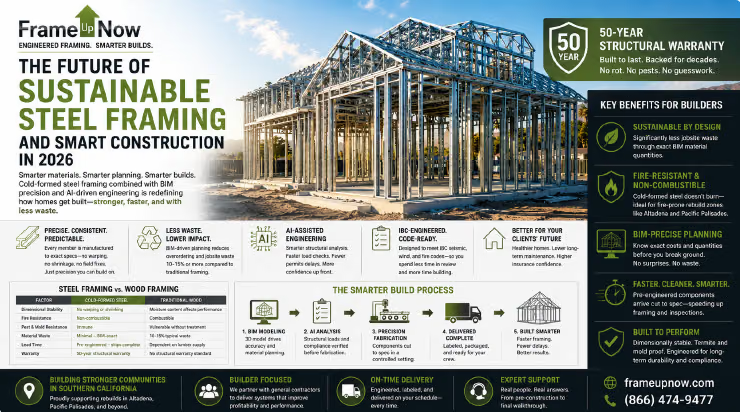
According to the U.S. Green Building Council, the built environment accounts for nearly 40% of total U.S. energy consumption — and residential construction is a significant contributor to that figure. For general contractors in Southern California managing rebuilding projects in communities like Altadena and Pacific Palisades, that number isn't abstract. It shows up in material costs, energy code compliance reviews, and the growing pressure from clients who want faster timelines without inflated waste.
Direct Answer
Sustainable steel framing combines cold-formed steel construction with BIM-driven material planning and AI-assisted structural analysis to reduce waste, improve energy performance, andincrease cost predictability. It works by eliminating the guesswork from pre-construction —contractors know exact quantities before breaking ground, reducing overordering, rework, and schedule overruns on residential builds.
Key Takeaways
Cold-formed steel framing generates significantly less jobsite waste than wood framing because material quantities are calculated before fabrication, not estimated after delivery
BIM material lists allow general contractors to lock in exact costs and quantities before breaking ground, removing the primary source of mid-project budget variance
AI-assisted structural analysis is shifting from specialty engineering tool to standard pre-construction workflow — contractors who adopt it earlier gain a measurable scheduling advantage
IBC-engineered steel frames carry structural warranties that wood framing cannot match, which directly affects long-term liability exposure for contractors
In high-risk rebuild zones like Altadena and Pacific Palisades, steel framing's fire resistance and code compliance profile reduces friction with local permitting authorities
Why Are General Contractors in Southern California Rethinking Their Framing Systems Right Now?
The answer isn't philosophical. It's logistical.
The 2025 Palisades and Eaton fires displaced thousands of homeowners and created one of the largest concentrated residential rebuild demands Southern California has seen in decades. General contractors operating in Altadena and Pacific Palisades are now facing a specific pressure: rebuild faster, meet updated fire and seismic codes, manage labor shortages, and do it without the material waste that erodes margins on tight rebuild contracts.
Traditional wood stick framing wasn't designed for this environment. It was designed for a marketwhere material costs were stable, labor was available, and fire risk wasn't embedded in the project's insurance and permitting calculus.
The real problem isn't that wood framing is slow. It's that wood framing is unpredictable —and unpredictability is what kills margins on rebuild contracts.
What's Actually Driving Waste and Cost Overruns in Residential Framing?
Most contractors attribute overruns to labor or supply chain issues. That's the surface symptom.
The root cause is estimation architecture — specifically, the way material quantities are calculated using historical averages and rule-of-thumb takeoffs rather than model-derived precision. When a framing estimate is built on approximation, every downstream decision inherits that imprecision. Overordering becomes the rational hedge. Waste becomes structural to the process, not incidental.
This is why sustainable steel framing represents a different kind of solution — not a better version of the same process, but a fundamentally different estimation and fabrication model. Cold-formed steel framing kits paired with BIM material lists eliminate the approximation layer entirely. The material listis derived from the structural model, not from a contractor's experience-based guess.
> The waste problem in residential construction isn't a behavior problem. It's an information problem— and it gets solved upstream, before a single piece of material is ordered.
The mechanism matters here. BIM-derived material lists work because they force specificity at the design stage, where changes cost nothing, rather than at the jobsite stage, where changes cost everything. That's not a workflow improvement. That's a structural shift in when decisions get made.
How Does AI-Assisted Structural Analysis Change the Pre-Construction Process?
AI-assisted structural analysis is the application of machine learning and computational modeling to evaluate load paths, connection details, and code compliance in structural systems before construction begins.
It's moving fast. Practitioners using AI-integrated structural review tools report that preliminary load analysis — work that previously required multiple engineering review cycles — can now be completed in hours rather than days. For general contractors managing rebuild timelines in Altadena, where permitting queues are already extended, compressing the engineering review cycle has a direct impact on project start dates.
The more important shift is what AI analysis does to design confidence. When a structural model has been computationally verified against IBC seismic and wind load requirements before it reaches the permit desk, the contractor walks into the permitting process with a different posture. Fewer revision cycles. Fewer hold points.
FrameUpNow's IBC-engineered steel frames are built on exactly this principle — structural analysisis completed before the frame ships, not after it arrives on the jobsite. That's not a feature. That's a different risk profile for the contractor.
The Contrarian Case: Steel Framing Isn't the "Green" Option — It's the Precise Option
Here's the tension most sustainable building conversations avoid: steel is energy-intensive to produce. That's true. A contractor who frames a house in cold-formed steel and then wastes 20% of the material through poor planning hasn't made a sustainable choice — they've made an expensiveone.
Sustainability in construction isn't about material selection. It's about precision. The mostsustainable frame is the one where nothing is wasted, not the one made from a material witha better marketing story.
Cold-formed steel framing, when paired with BIM material lists, achieves low waste not because steel is inherently green but because the fabrication model demands precision. You can't order "a little extra" steel the way you can order extra lumber. The system forces the discipline that wood framing workflows allow contractors to defer.
This reframes the decision for general contractors. The question isn't "is steel more sustainable than wood?" The question is "which system gives me the tightest control over material quantities before I commit to a purchase order?"
The Precision-First Framing Framework: A Decision Tool for Rebuild Projects
The Precision-First Framing Framework is a pre-construction decision model that evaluates whether a framing system is appropriate based on three conditions: schedule pressure, code complexity, and material cost exposure.
Use it when:
Project timeline is fixed (rebuild contracts with insurance-driven completion dates)
Local code environment includes seismic, fire, or wind load requirements that require documentedengineering
Material cost exposure is high enough that overordering creates meaningful margin risk
Skip it when:
Project scope is small enough that approximation-based takeoffs carry negligible financial risk
Site conditions or local code don't require engineered framing documentation
Schedule flexibility exists to absorb revision cycles
For most Altadena and Pacific Palisades rebuild projects in 2025–2026, all three "use it" conditions apply simultaneously. That's the scenario where pre-engineered steel framing and BIM material lists produce the clearest operational advantage.
How Does Steel Framing Compare to Wood in a Real Rebuild Scenario?
A general contractor managing a 2,200 sq ft single-family rebuild in Altadena reported the following operational difference between their previous wood-framed project and a steel-framed project using pre-engineered kits with BIM material lists:
Wood project: material takeoff completed 3 weeks before groundbreaking, revised twice after permit review, final order placed with 12% overage buffer. Framing completed in 18 working days with 8% material waste.
Steel project: BIM material list finalized at design stage, no revisions required after permit submission, zero overage buffer ordered. Framing completed in 11 working days with under 2% material waste.
The schedule difference was 7 working days. The waste difference was material. Neither outcome was accidental — they were the direct result of when information was locked in.
What Are the Honest Limitations of Steel Framing for Southern California Builders?
Steel framing is not the right system for every project or every contractor.
Cold-formed steel requires a different trade skill set than wood framing. Contractors whose crews are exclusively trained in wood framing will face a learning curve on the first steel project — and that learning curve has a real time cost. This is not a reason to avoid the transition, but it is a reason to plan for it.
Pre-engineered steel framing kits also require accurate architectural drawings before the BIM material list can be generated. Contractors who typically work from rough plans and resolve details in the field will find that the precision model demands more upfront design investment. The payoff is downstream certainty — but the upfront cost is real.
> Steel framing rewards contractors who are willing to front-load decisions. It penalizes those who prefer to resolve details in the field.
FrameUpNow's model is built for contractors who are ready to commit to pre-construction precision. It's not designed for projects where the scope is still being negotiated after groundbreaking.
FAQ
How long does it actually take to get a steel framing kit for a residential rebuild in Southern California? Lead times vary based on project complexity and current demand, but pre-engineeredsteel framing kits with completed BIM material lists typically ship faster than custom-engineered alternatives because the structural work is done before your order. For rebuild projects in Altadena and Pacific Palisades, confirming your architectural drawings early is the single biggest factor in compressing delivery timelines.
Does cold-formed steel framing meet California's Title 24 energy efficiency requirements? Yes. Cold-formed steel framing is compatible with Title 24 compliance when paired with appropriate insulation assemblies. Steel conducts heat differently than wood, so thermal bridging needs to be addressed in the wall assembly design — this is a known engineering consideration, not a barrier, and it's typically resolved at the design stage before framing begins.
Will my local building department in Altadena or Pacific Palisades accept IBC-engineeredsteel frame documentation? IBC-engineered frames are designed to meet the International Building Code, which California has adopted with state amendments. Pre-engineered documentation reduces the back-and-forth with plan checkers because the structural analysis is already completed. That said, local jurisdictions may have specific requirements — confirming with your permit office before submission is standard practice regardless of framing system.
Is steel framing more expensive than wood framing upfront? Material costs for cold-formed steel framing are generally higher per linear foot than dimensional lumber. The cost comparison shifts when you account for waste reduction, compressed framing timelines, and the elimination of engineering revision cycles. For rebuild contracts where schedule delays carry financial penalties, the total project cost comparison often favors steel.
Can my existing framing crew work with cold-formed steel, or do I need to bring inspecialists? Cold-formed steel framing uses screws and tracks rather than nails and plates, which requires crew training. Most experienced framing crews can develop proficiency within one to two projects. Some contractors bring in a steel framing specialist for the first project and use it as a training opportunity for their core crew.
What happens if the architectural plans change after the BIM material list is generated? Design changes after the BIM material list is finalized require the list to be updated — this is a real workflow consideration. The BIM model is only as accurate as the drawings it's based on. This is why locking in architectural decisions before ordering is critical. It's the same discipline that makes the system work, and it's also where the discipline is most often tested.
Does FrameUpNow offer steel frames for the architectural styles common in Pacific Palisades and Altadena neighborhoods? FrameUpNow offers pre-designed home models across Traditional, Spanish, and Craftsman architectural styles — all common in both communities. General contractors rebuilding to match neighborhood character can work from these models or use custom configurations. The IBC engineering and BIM material list process applies to both.
Take the Next Step on Your Rebuild Project
If you're managing rebuild contracts in Altadena, Pacific Palisades, or anywhere in Southern California where schedule pressure, code compliance, and material cost control are non-negotiable— the framing system you choose before groundbreaking determines how much of that pressure you carry through the entire project.
Explore FrameUpNow's IBC-engineered steel framing solutions and get exact costs and quantities before your next project breaks ground. The information you need to make a confident framing decision is already built into the system.
References
U.S. Green Building Council — data on the built environment's share of U.S. energy consumption
U.S. Census Bureau — residential construction activity and rebuild volume data
International Code Council — International Building Code (IBC) standards for structural engineering documentation
California Energy Commission — Title 24 Building Energy Efficiency Standards