






















.avif)

Cold-Formed Steel Framing vs. Traditional Wood Framing: Which Is Better?
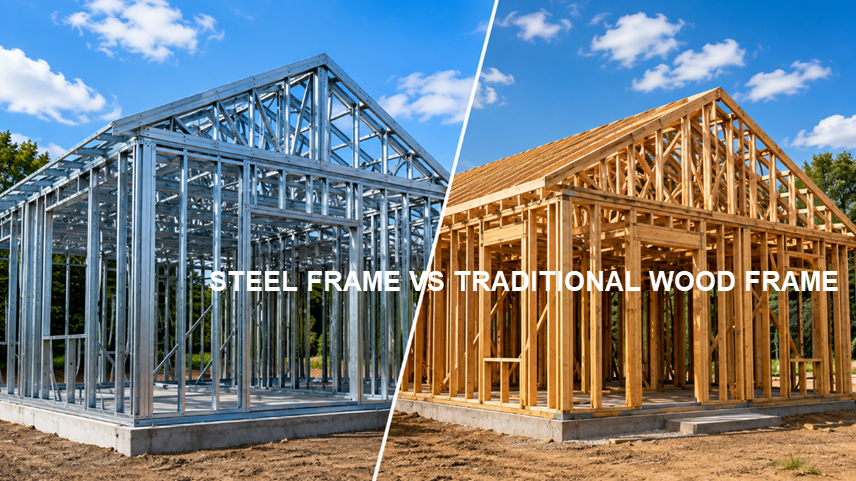
Choosing the structural framing material is one of the mostimportant decisions when building a home, accessory dwelling unit, garage, or other residential structure.
Traditional wood framing remains common throughout residential construction, but cold-formedsteel framing provides an engineered alternative with greater dimensional consistency, resistance to pests and rot, and non-combustible structural components.
Which framing material is better? The answer depends on the project, location, budget, design, labor availability, and long-term building priorities.
Quick Answer: Is Steel Framing Better Than Wood Framing?
Cold-formed steel framing generally provides better dimensional stability, pest resistance, fire performance, material precision, and long-term durability than traditional wood framing. Wood may be easier to modify in the field and may have a lower initial material cost in some markets. However, an engineered and panelized steel framing system can reduce waste, field cutting, construction uncertainty, and long-term maintenance concerns.
The best choice should be based on total project value—notsimply the price of the framing material.
What Is Cold-Formed Steel Framing?
Cold-formedsteel framing is created by passing metallic-coated sheet steel through roll-forming equipment. The steel is shaped into structural components such as:
- Wall studs
- Tracks
- Floor joists
- Rafters
- Headers
- Beams
- Roof trusses
According to the American Iron and Steel Institute’s Build Using Steel resource, cold-formed steel is commonly used for repetitive light-frame construction in low-rise and mid-rise buildings.
The components are manufactured to precise dimensions rather than cut from naturally variable building material.
At FrameUpNow, architectural plans are converted into IBC-engineered cold-formed steel framing systems. Building Information Modeling, engineered structural analysis, and precision manufacturing are used to create the components and documentation required for each project.
What Is Traditional Wood Framing?
Traditional wood framing uses dimensional lumber—commonly 2×4 or 2×6 members—to create the walls, floors, and roof structure of a building.
The lumber is measured, cut, and fastened together at the jobsite. Wood remains widely used because:
- Builders and tradespeople are familiar with it
- It is readily available in most markets
- Standard carpentry tools can be used
- Jobsite modifications are relatively easy
- Fixtures and finishes can be attached using familiar methods
However, wood is a natural material. Its dimensions, moisture content, grain, knots, strength, and long-term movement can vary from one piece to another.
Cold-Formed Steel vs. Wood Framing
1. Strength and Structural Performance
Cold-formed steel has a high strength-to-weight ratio and provides consistent structural properties.
Each FrameUpNow system is engineered for the conditions that apply to the project, including applicable wind, snow, and seismic requirements. Learn more about the components and documentation in a FrameUpNow steel frame package.
Cold-formed steel framing:
- Does not shrink as it dries
- Does not warp or twist
- Provides consistent dimensions
- Can be engineered for project-specific structural loads
- Maintains predictable structural properties
Wood framing can also provide strong structural performance when properly engineered, selected, installed, and protected. However, the natural characteristics of lumber can cause individual pieces to bow, twist,split, or shrink.
2. Fire and Combustibility
Cold-formed steel is a non-combustible framing material. It does not provide fuel to a building fire.
This does not make an entire steel-framed home fireproof. Exterior cladding, insulation, roofing, windows, interior finishes, landscaping, vents, and construction details must all be considered as part of a complete fire-resistant building system.
Nevertheless, non-combustible framing can be particularly valuable in wildfire-prone areas. The Build Using Steel fireand safety resources explain how steel can contribute to building safety and resilience.
Wood framing is combustible and can contribute fuel when exposed to fire. Building codes address this risk through required wall assemblies, protective finishes, fire blocking, setbacks, and other construction requirements.
Explore FrameUpNow’s Non-Combustible Home video collection for additional information about the role framing materials playin fire-conscious construction.
3. Termite and Pest Resistance
Cold-formed steel does not provide a food source fo termites, carpenter ants, or other wood-destroying insects.
Steel framing:
- Cannot be eaten by termites
- Does not require treatment for wood-destroying insects
- Does not conceal the same type of structural wood damage
- Can reduce concerns associated with pest-related framing deterioration
Wood framing can perform for generations when properly protected, but it remains susceptible to termites and other wood-destroying organisms.
4. Moisture, Rot, and Mold
Galvanized cold-formed steel does not absorb moisture or rot like wood.
Steel is also not an organic food source for mold. However, moisture can still affect insulation, drywall, finishes, and other materials surrounding the frame. Proper flashing, drainage, ventilation, vapor control, and building-envelope design remain essential.
Wood framing can absorb and release moisture. If it remains wet for an extended period, the material may swell, warp, support mold growth, or eventually decay.
5. Dimensional Stability
Dimensional stability is one of the clearest differences between steel and wood framing.
Cold-formed steel components do not:
- Shrink
- Split
- Bow
- Twist
- Warp because of changing moisture content
This consistency can contribute to straighter walls, more accurate openings, and predictable placement of building components.
Wood moves as its moisture content changes. Even properly dried lumber may experience some movement after installation.
6. Construction Speed
Construction speed depends on project size, crew experience, foundation accuracy, site access, weather, equipment, inspections, and the way the framing package is prepared.
Traditional wood framing is familiar to many crews and can be installed quickly by experienced carpenters. However, it commonly involves field measuring, cutting, sorting, and material adjustments.
FrameUpNow uses BIM-based planning, precision-manufactured components, labeled members, engineered trusses, and panelized sections to reduce jobsite cutting and guesswork.
A FrameUpNowsteel frame package may include:
- IBC-engineered structural plans
- BIM-derived material quantities
- Pre-cut and labeled components
- Wall panels
- Beams and headers
- Roof trusses
- Fasteners and hardware
- Assembly documentation
- Instructional support
See the framing and assembly process in the FrameUpNow video library.
7. Material Waste
Traditional wood framing frequently requires lumber to be cut at the jobsite. Offcuts, damaged pieces, warped boards, temporary bracing, and ordering allowances can contribute to construction waste.
Cold-formed steel components can be manufactured to specified lengths before delivery, helping reduce field cutting and unused material.
Steel offcuts are also recyclable. The environmental value of either framing system should still be evaluated across its complete lifecycle, including raw-material production, transportation, construction waste, building performance, service life, and end-of-life recovery.
8. Cost
There is no universal answer to whether steel framing or wood framing costs less.
Wood may have a lower initial material price in some locations. Its widespread availability and contractor familiarity may also reduce initial labor costs.
Cold-formed steel may provide savings or additional value through:
- Predictable material quantities
- Reduced jobsite cutting
- Lower framing waste
- Fewer damaged or unusable components
- Resistance to termites and rot
- Dimensional stability
- Long service life
- Potentially faster framing with panelized systems
- Reduced exposure to certain construction risks
The correct comparison is the total installed andlong-term cost, not simply the price of steel studs compared with lumber.
FrameUpNow provides a CostEstimator within each plan to help prospective owners examine the steel skeleton cost alongside planning estimates for foundation, labor, site work, finishes, shipping, and other construction categories.
9. Sustainability
Both steel and wood can support sustainable construction when responsibly sourced, efficiently used, and properly designed.
Sustainability Advantages of Wood
Wood:
- Is renewable when responsibly harvested
- Stores carbon during its service life
- Requires relatively little energy to shape into framing lumber
- Is widely available
Its environmental performance can be reduced by excessive waste, short service life, pest damage, moisture damage, or unsustainable forestry practices.
Sustainability Advantages of Cold-Formed Steel
Cold-formed steel:
- Is recyclable
- Can contain recycled material
- Can be manufactured to precise project quantities
- Produces recyclable manufacturing and construction offcuts
- Provides a long service life
- Does not require replacement because of termites or rot
Project-specific life-cycle analysis provides a more reliable sustainability comparison than broad claims that one material is always environmentally superior.
10. Design Flexibility
Wood is easy to cut and alter with standard carpentry tools, making field modifications relatively straight forward.
Cold-formed steel also supports a wide variety of architectural designs, but it performs best when decisions are coordinated before manufacturing. BIM and digital engineering allow openings, roof geometry, loads, dimensions, and connections to be resolved before the framing components are produced.
This approach changes the objective from modifying the structure in the field to preventing avoidable field modifications.
The AISI cold-formed steel design standards provide established practices for designing and installing structural and nonstructural cold-formed steel framing.
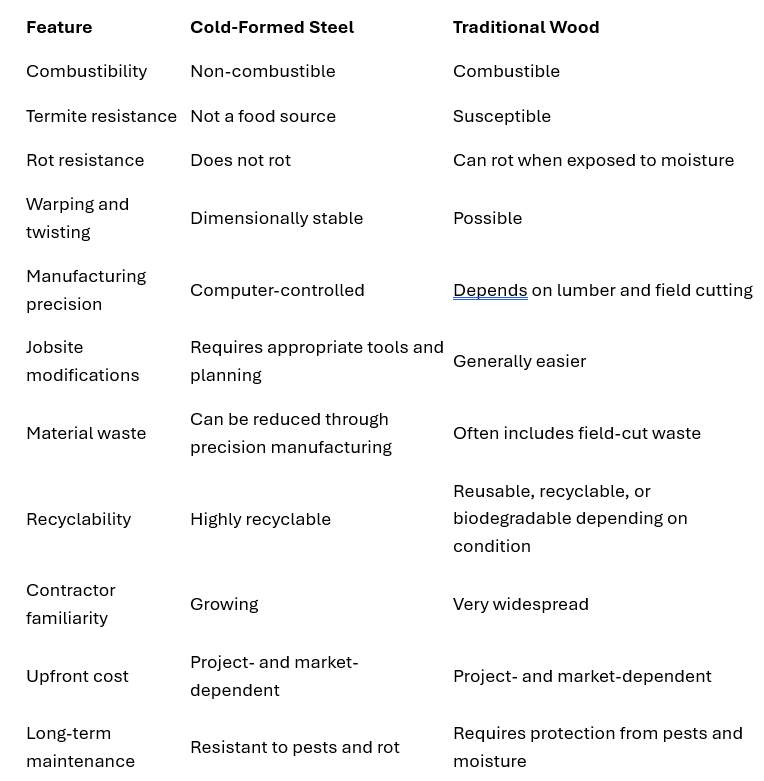
Cold-Formed Steel vs. Wood Comparison
What Are the Disadvantages of Cold-Formed Steel Framing?
Cold-formed steel offers important benefits, but it is not without project considerations.
Potential disadvantages include:
- Fewer residential crews may have steel-framing experience
- Specialized cutting and fastening tools may be needed
- Improperly designed steel walls can create thermal bridging
- Field changes require coordination with structural plans
- Initial material costs may be higher in some markets
- Connections and assemblies must follow engineered requirements
Proper insulation and wall-assembly design are especially important because steel conducts heat more readily than wood. The AISI thermal design resources provide guidance for addressing thermal performance in cold-formed steel building envelopes.
What Are the Disadvantages of Wood Framing?
Potential wood-framing disadvantages include:
- Combustibility
- Termite vulnerability
- Potential rot and moisture damage
- Warping, twisting, splitting, and shrinking
- Variation among individual pieces
- Field-cut material waste
- Dependence on skilled framing labor
- Possible price volatility
Proper design, moisture protection, pest prevention, quality lumber, and skilled installation can help reduce many of these risks.
Frequently Asked Questions
Is cold-formed steel stronger than wood?
Cold-formed steel provides a high strength-to-weight ratio and predictable engineered properties. The performance of either framing system ultimately depends on the complete structural design, member sizing, connections, installation, loads, and applicable building requirements.
Is steel framing more expensive than wood framing?
Steel may have a higher initial material cost in some markets, but material price alone does not determine total project cost. Labor, waste, engineering, speed, repairs, insurance considerations, maintenance, andservice life should also be included.
Can termites damage a steel-framed home?
Termites cannot consume the steel framing. However, othe rwood-based materials in the home—such as cabinets, trim, sheathing, furniture, or landscaping features—may still require termite protection.
Does cold-formed steel rust?
Structural cold-formed steel is commonly manufactured with a metallic protective coating. Proper storage, installation, moisture management, and approved detailing help protect the framing from corrosion during construction and throughout the building’s service life.
Is cold-formed steel suitable for wildfire-prone areas?
Yes. Cold-formed steel is non-combustible and can be an important component of fire-conscious construction. However, wildfire resilience depends on the entire building system, including the roof, exteriorwalls, windows, vents, decks, landscaping, and defensible space.
Is a steel-framed home energy efficient?
A steel-framed home can be highly energy efficient when insulation, continuous exterior insulation, air sealing, windows, mechanical systems, and thermal-bridge control are properly designed. Energy performance depends on the complete building envelope rather than the framing material alone.
Can architectural wood plans be converted to steel framing?
Yes. FrameUpNow can convert qualifying architectural plans into an engineered cold-formed steel structural system. Learn how the company combines engineering, BIM, material planning, and manufacturing in The FrameUpNow Story.
Which Framing Material Is Better?
Wood remains a practical and familiar material for many residential projects. It is widely available, easy to modify, and supported by a large labor force.
Cold-formed steel is often the better choice when the project prioritizes:
- Non-combustible framing
- Resistance to termites and rot
- Dimensional stability
- Precision manufacturing
- Reduced jobsite cutting
- BIM-based material planning
- Long-term durability
- Predictable engineered performance
The final decision should consider the project location, design, local construction market, labor, code requirements, budget, insurance environment, construction schedule, and long-term ownership goals.
Build with Precision-Engineered Steel Framing
FrameUpNow converts architectural designs into engineered cold-formed steel framing systems with BIM-derived material quantities, precision-manufactured components, panels, trusses, documentation, and assembly support.
ExploreFrameUpNow’s steel framing process, review what is included in a steel frame package, or watch the FrameUpNow construction videos to determine whether cold-formed steel is right for your home, ADU, garage, or rebuild.