























.avif)

The Home You Build Today May Be Uninsurable Tomorrow
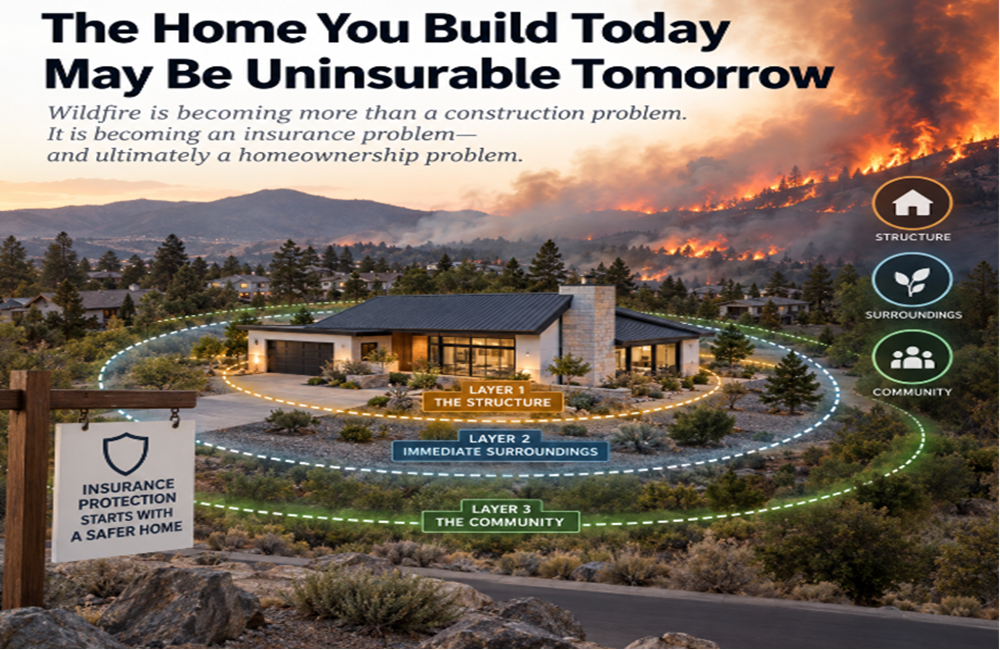
Wildfire is becoming more than a construction problem. It is becoming an insurance problem—and ultimately a homeownership problem.
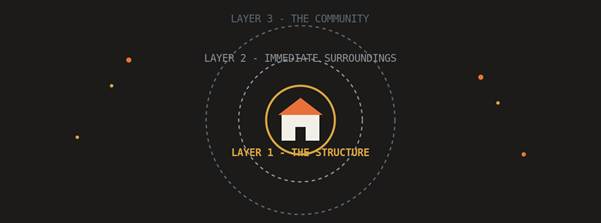
Three layers of insurance protection: the structure, the immediate surroundings, and the community.
For generations, buying a home meant thinking about the mortgage.
Then came property taxes.
Then maintenance.
Increasingly, there is another question that may determine whether a home is truly affordable:
Can you insure it?
In wildfire-prone areas, that question is becoming increasingly difficult to ignore.
As catastrophic fires destroy entire neighborhoods, insurers face losses measured not in individual houses, but in thousands of structures at once.
Homeowners feel the consequences through higher premiums, larger deductibles, restricted coverage and, in some markets, fewer insurance choices.
That leads to a provocative question:
COULD THE HOME YOU BUILD TODAY BECOME THE HOME YOU CANNOT AFFORD TO INSURE TOMORROW?
INSURANCE FOLLOWS RISK
Insurance works by pricing risk.
When the probability and severity of loss increase, the economics of insurance change.
Wildfire presents a particularly difficult challenge because it can produce correlated losses—many insured properties suffering catastrophic damage from the same event.
A single house fire is one claim.
A wildfire that destroys an entire subdivision can produce hundreds or thousands of claims from one event.
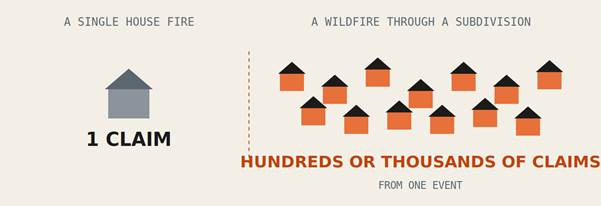
Fig. 1 — Wildfire's defining challenge for insurers is correlated loss: many properties, one event, one claims wave.
That distinction matters enormously to insurers. And it means the construction of the individual home may no longer be the only issue.
The concentration of homes and the potential for fire to spread from one structure to another become part of the risk.
The Insurance Institute for Business & Home Safety (IBHS) has increasingly approached wildfire at both the individual-property and neighborhood level. In 2026, IBHS formally expanded its Wildfire Prepared program to include standards for single-family homes, multifamily properties and entire neighborhoods, with the stated goal of reducing home ignition and structure-to-structure fire spread.
That is a significant shift. Insurance is beginning to ask a different question:
HOW MUCH RISK CAN WE REMOVE BEFORE THE FIRE STARTS?
THE INSURANCE INDUSTRY IS NOT WAITING FOR THE NEXT FIRE
The idea that insurers may eventually reward wildfire-resilient homes is not theoretical.
California already has a formal mechanism for doing so.
The state's Safer from Wildfires program requires insurers to provide discounts for qualifying wildfire-mitigation actions. The California Department of Insurance describes the program as addressing three layers of protection:
the structure, the immediate surroundings and the community.
That is strikingly similar to the concept developed in our first article.
The house matters. The five feet around the house matters. The neighborhood matters. And mitigation can affect insurance economics.
California's Department of Insurance reports that required wildfire-mitigation discounts can range from 4% to 40%, depending on the level of wildfire risk and the mitigation measures involved.

Fig. 2 — California Department of Insurance, Safer from Wildfires program. Actual discount depends on risk level and mitigation measures present.
That does not mean every homeowner will receive a 40% discount. It does mean that wildfire mitigation has entered the insurance pricing conversation in a very concrete way.
INSURANCE IS BEGINNING TO RECOGNIZE THE DIFFERENCE BETWEEN RISK AND REDUCED RISK
This may be one of the most important changes in the way we think about housing.
Historically, a home in a wildfire-prone area might largely be treated according to its location.
Increasingly, insurers and regulators are asking:
WHAT HAS THE HOMEOWNER DONE TO REDUCE THE RISK?
That can include measures such as:
● Class A roofing
● Ember-resistant vents
● Defensible space
● A noncombustible Zone 0
● Appropriate windows and doors
● Noncombustible or fire-resistant exterior materials
● Protection of decks and other vulnerable structures
● Community-level mitigation
IBHS's Wildfire Prepared Home program organizes mitigation into two levels: an Essential level focused primarily on wind-driven embers and an Enhanced level that adds protection against radiant heat and direct flame contact.
The important concept is not the name of the program. It is the principle:
RISK CAN BE REDUCED THROUGH MEASURABLE CHANGES TO THE PROPERTY AND ITS SURROUNDINGS.
And when risk can be measured, it can increasingly become part of an insurance conversation.
THE ECONOMICS OF REBUILDING ARE CHANGING THE CONVERSATION
Consider what happened in Los Angeles.
After the 2025 Palisades and Eaton fires, the California Department of Insurance and the National Association of Insurance Commissioners conducted an analysis of what would happen if the destroyed communities were rebuilt to the IBHS Wildfire Prepared Home standard.
Their conclusion was striking:
~1/3 reduction in projected wildfire losses if rebuilt to the IBHS Wildfire Prepared Home standard
4–40% range of California mitigation-based insurance discounts, depending on risk and measures taken
The study did not say that these homes could never burn. It did not say that every homeowner would receive a specific insurance premium.
It showed something potentially more important:
Better construction and mitigation can materially change the expected loss.
And expected loss is at the heart of insurance. That creates an entirely new economic equation for home construction.
THE COST OF A HOUSE ISN'T THE COST OF OWNING A HOUSE
Suppose Builder A constructs a home for $400,000.
Builder B constructs a substantially more wildfire-resilient home for $420,000.
At first glance, Builder A has won. The house costs $20,000 less.
But now consider the lifetime economics.
● What does Builder A's buyer pay for insurance?
● What happens if premiums rise?
● What happens if the deductible increases?
● What happens if coverage becomes restricted?
● What happens if the insurer leaves the market?
● What happens to the home's resale value if future buyers have difficulty obtaining insurance?
● And what happens if the home is destroyed?
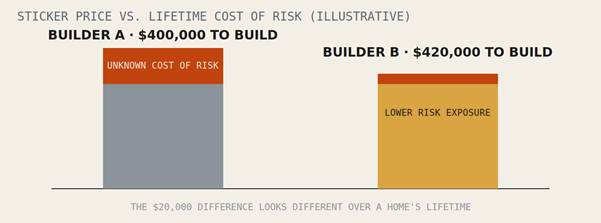
Fig. 3 — Illustrative only: the $20,000 difference in construction cost looks different once the cost of risk is added across a home's lifetime.
The $20,000 difference suddenly looks different. The relevant comparison may not be:
$400,000 VERSUS $420,000.
it may be
THE COST OF CONSTRUCTION VERSUS THE COST OF RISK.
THE 5% QUESTION
This leads to a question we should be asking more often.
WHAT IF BUILDING A MORE WILDFIRE-RESILIENT HOME COSTS 5% MORE?
Five percent is not a universal number. Actual costs depend on design, location, materials, labor, code requirements and the level of mitigation.
But let's use 5% as a thought experiment. On a $400,000 construction cost, five percent is $20,000.
Would the homeowner spend $20,000 to reduce the probability of catastrophic loss? Perhaps.
Would the homeowner spend $20,000 if it also improved the home's insurance position? Perhaps.
Would a developer spend the money if an entire subdivision could demonstrate measurable wildfire resilience? That becomes an even more interesting question.
And what if insurers eventually recognize the difference?
Then the additional construction cost isn't simply an expense. It becomes an investment in risk reduction.
We should not promise that it will pay for itself. But we should absolutely ask whether it can.
THE INSURANCE INDUSTRY IS BEGINNING TO CONNECT MITIGATION AND INSURABILITY
There is evidence that this connection is already developing.
In 2026, California reported that major insurers were making commitments to expand homeowners coverage in wildfire-distressed areas, while also increasing discounts for mitigation measures such as ember-resistant vents, Class A roofing and defensible space.
California has also reported that some insurers have committed to writing policies for homes meeting the IBHS Wildfire Prepared Home standard.
This is important because the future insurance question may not be simply:
"WHAT IS MY PREMIUM?"
it may be
"WILL ANYONE WRITE MY POLICY?"
That is a much bigger question.
THE INSURANCE PROBLEM CAN BECOME A HOUSING PROBLEM
Imagine a community where insurance becomes increasingly expensive.
Some homeowners will absorb the cost. Some will sell. Some prospective buyers will decide they cannot afford the property. Some lenders may face additional concerns about insurance availability and adequacy. And developers may discover that building homes that are difficult to insure creates a market problem.
In other words:
AN INSURANCE CRISIS CAN BECOME A HOUSING AFFORDABILITY CRISIS.
This is why wildfire resilience should not be viewed solely as an environmental issue or a construction issue.
It is also an economic issue. It is a community issue. And ultimately, it is a homeownership issue.
WHAT DOES THIS MEAN FOR NEW CONSTRUCTION?
New construction presents an unusual opportunity.
An existing home may require expensive retrofits to improve wildfire resilience. A new home can be designed around the risk from the beginning.
● The architect can consider the roof.
● The engineer can consider the structural system.
● The builder can consider the exterior envelope.
● The designer can specify ember-resistant vents.
● The site plan can incorporate defensible space.
● The developer can consider the relationship between neighboring structures.
● And the entire community can be designed with wildfire resilience in mind.
That is a very different proposition from trying to retrofit an entire subdivision after it has been built.
WHERE NONCOMBUSTIBLE CONSTRUCTION ENTERS THE CONVERSATION
This brings us back to the central idea of the FrameUpNow® wildfire series.
If fire follows fuel, perhaps one of the most logical places to begin is with the building itself.
Cold-formed steel framing is noncombustible.
That does not make a house fireproof. It does not eliminate combustible contents. It does not eliminate wildfire risk.
But it does eliminate one major category of combustible structural material. And it can become one component of a larger wildfire-resilient building system that includes appropriate roof systems, exterior assemblies, insulation, windows, doors, vents and defensible space.
The objective is not to find one material that solves wildfire.
The objective is to eliminate as many pathways to ignition as practical. That is a fundamentally different way of approaching construction.
WHAT IF THE INSURANCE PREMIUM BECOMES PART OF THE CONSTRUCTION DECISION?
For decades, builders and buyers have focused heavily on the first cost of construction. Perhaps that needs to change.
When evaluating a home, the buyer of the future may need to ask:
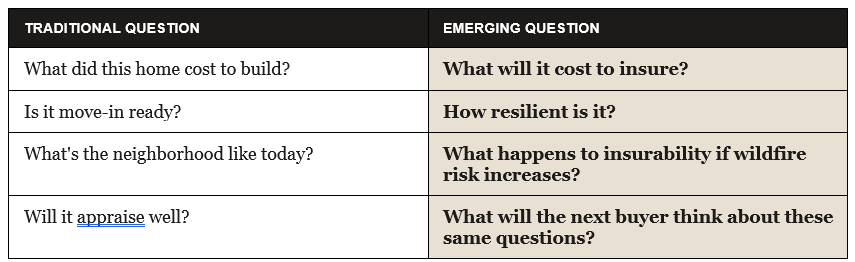
A slightly more expensive house that is easier to insure may ultimately be a better economic proposition. Again, that is not a guarantee. It is an emerging possibility. And it deserves serious attention from builders, developers, insurers and homeowners.
THE DEVELOPER MAY HAVE THE BIGGEST OPPORTUNITY
The individual homeowner can harden a house. A developer can do something much bigger.
A developer can build an entire community around the principle of reducing ignition and fire spread.
Imagine a subdivision where:
● Homes meet a recognized wildfire-resilience standard.
● The immediate five feet around each home are noncombustible.
● Roofs are designed for severe wildfire exposure.
● Ember-resistant vents are standard.
● Fences and decks are designed to reduce connective fuels.
● Homes use noncombustible materials wherever practical.
● The neighborhood itself is evaluated for structure-to-structure fire spread.
That community could potentially offer something its competitors do not:
A measurable approach to wildfire risk.
And IBHS is already moving in this direction with its Wildfire Prepared Neighborhood standard.
The question for developers may eventually become:
WOULD BUYERS PAY A PREMIUM FOR A NEIGHBORHOOD THAT IS EASIER TO INSURE?
That is a question the market will ultimately answer.
WE SHOULD STOP THINKING ONLY ABOUT THE PRICE OF THE HOUSE
The cheapest house to build may not be the cheapest house to own.
The cheapest house to construct may not be the easiest house to insure.
And the lowest initial construction cost may not produce the lowest lifetime cost.
That is the larger lesson.
THE NEXT GENERATION OF AFFORDABLE HOUSING MAY NEED TO BE AFFORDABLE TO INSURE.
If wildfire risk continues to increase in some regions, the construction industry will have to respond. Insurance companies will respond. Homebuyers will respond. Developers will respond.
The question is whether we respond before the next catastrophic loss—or after it.
BUILD FOR INSURABILITY
FrameUpNow® believes the conversation about wildfire-resilient construction should begin with a simple principle:
BUILD THE HOUSE TO REDUCE THE RISK BEFORE THE FIRE ARRIVES.
Not because anyone can promise that a house will never burn. Not because steel is a magic answer. Not because every wildfire can be stopped.
But because the industry has an opportunity to reduce combustible fuel, reduce ignition pathways and improve the resilience of both individual homes and entire communities.
And if doing so also improves the economics of insurance, we may discover something important:
The more resilient home may ultimately be the more affordable home.
The home you build today may stand for 50, 75 or even 100 years. Perhaps one of the questions we should ask before we build it is not simply:
"WHAT WILL IT COST?"
but
"WILL WE STILL BE ABLE TO INSURE IT?"