

What Is an ADU, and Why Are ADUs Booming?
By Rodger Ford, Founder and CEO, FrameUpNow · November 24, 2026 · 8 min read
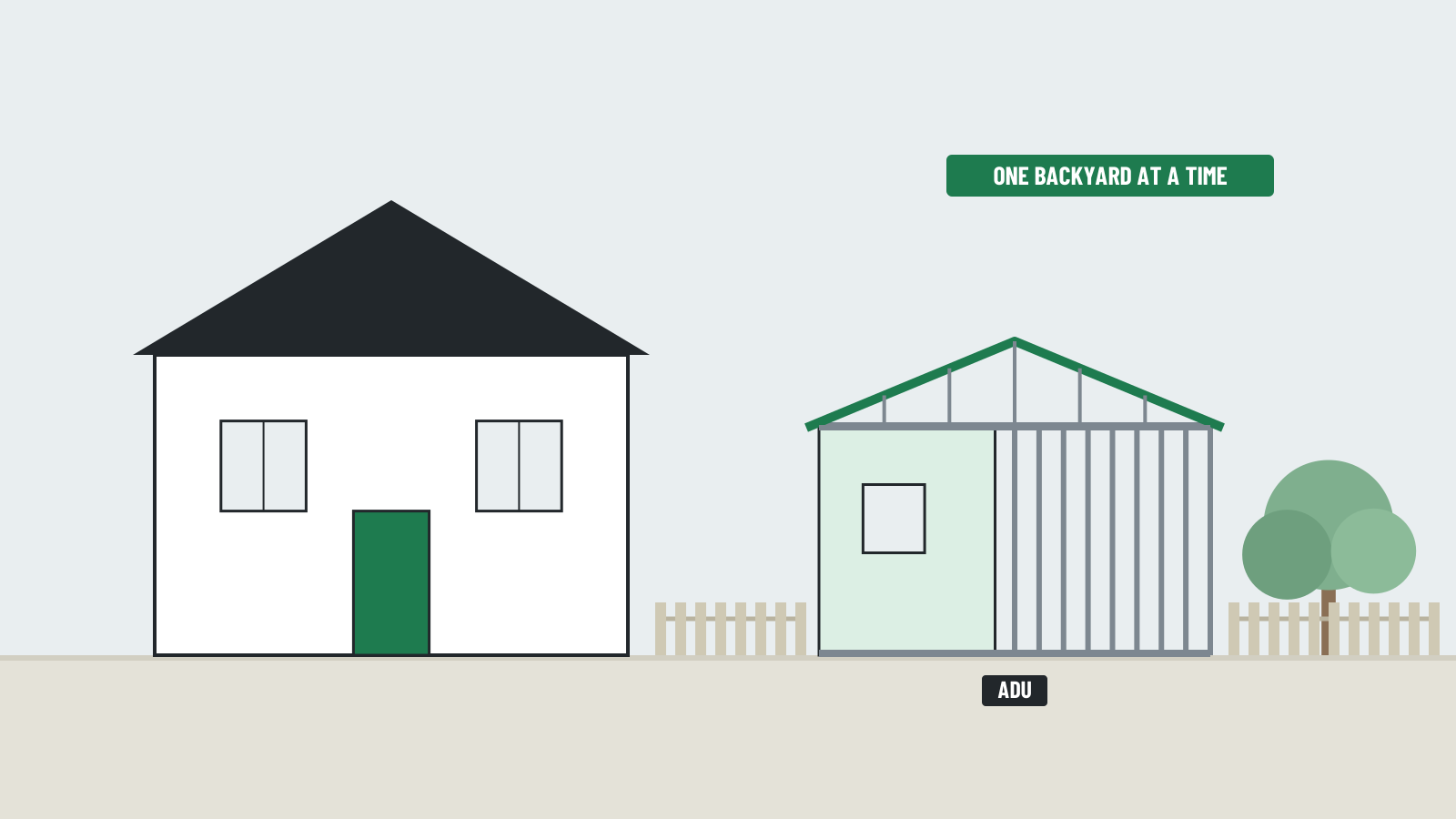
One backyard at a time: a small home behind an existing house adds housing without new land, roads or utility lines. (Illustration)
KEY TAKEAWAYS
Estimates of the U.S. housing shortage range from about 1 million to 10 million homes, depending on what's measured.
ADU permits rose about 1,100% from 2015 to 2025 and now make up about 7% of all U.S. residential permits.
California leads with about 41,000 ADU permits, 52 for every 100 conventional homes. Arizona has about 1,600, or 5 per 100.
ADUs add homes in the neighborhoods where they're scarcest, without new land, roads or utility lines.
In 2026, a new federal law, 18 state ADU laws and thousands of free permit-ready plans are pushing growth further.
Short answer: An ADU, or accessory dwelling unit, is a small, complete second home on the same lot as a house. ADUs are booming because they add homes where the shortage hurts most, on lots that already have streets, water and power. According to Cotality, ADU permits rose about 1,100% from 2015 to 2025 and now make up about 7% of all U.S. residential permits. New federal and state laws, and thousands of free permit-ready plans, are speeding that growth in 2026.
How big is the U.S. housing shortage?
Ask five housing economists how many homes America is short, and you'll get five answers. In April 2026 the White House Council of Economic Advisers put the number at 10 million single-family homes. Zillow says about 4.7 million. Realtor.com says roughly 4 million. John Burns Research and Consulting puts today's gap closer to 1 million.
They aren't really disagreeing about the facts. They're measuring different things. The White House counted the homes we would have if builders had kept their pre-2008 pace. Others count young adults still living with their parents who would move out if they could afford to. Others look only at today's vacancy rates.

Same shortage, four answers: John Burns about 1 million, Realtor.com about 4 million, Zillow 4.7 million, and the White House Council of Economic Advisers 10 million single-family homes.
Here's what every estimate agrees on: for more than 15 years, America built too little, and the people paying for it are first-time buyers, young families, aging parents and renters.
Why isn't building more homes enough?
Because the problem isn't only how many homes. It's where, and at what price. A researcher at John Burns made a point I think about often: build a million homes at $1.5 million each, and they'll sit empty. The shortage that hurts is a shortage of homes people can afford, in the neighborhoods where they already work, go to school and care for family.
Those neighborhoods are almost all zoned for single-family homes. There's rarely an empty lot, and rarely the political will for an apartment building. What there often is, is a backyard.
What is an ADU, and what does ADU stand for?
ADU stands for accessory dwelling unit. In real estate and housing, an ADU is a small, complete home on the same lot as a house: its own kitchen, its own bath, its own door. You may know it as a granny flat, casita, in-law unit, mother-in-law suite or backyard cottage. It can be a detached cottage, a garage conversion or a unit attached to the main house. Most run 400 to 1,200 square feet. The maximum size is set by your state and city, so check local rules before you choose a plan.
- Detached ADU: a separate backyard cottage or casita.
- Attached ADU: a unit added onto the main house with its own entrance.
- Garage conversion ADU: an existing garage turned into a complete home, reusing a structure that's already there.
Can you build an ADU on your property? It depends on your state and city rules, your zoning, and your lot's size, setbacks and utilities. Eighteen states now have statewide ADU laws, and you can test real plans on your own lot for free with the Plan Fit Visualizer.
How fast are ADUs growing?
Ten years ago, ADUs barely registered. According to Cotality's building-permit data, ADU permits rose about 1,100% between 2015 and 2025, and ADUs now make up about 7% of all residential permits nationwide. In Los Angeles and San Francisco, more ADU permits were issued in 2025 than permits for every other kind of housing combined.
In Los Angeles County, ADUs were more than a third of all new homes completed in 2025, according to USC's Neighborhood Data for Social Change project.
The fastest-growing home in America is the small one out back.
Which states build the most ADUs?
California is the clearest example, but it's no longer the only one. These are Cotality's top six states for ADU permits:
California · ADU permits: ~41,000 · ADUs per 100 conventional home permits: 52
Washington · ADU permits: ~2,200 · ADUs per 100 conventional home permits: 11
Florida · ADU permits: ~2,000 · ADUs per 100 conventional home permits: 1
Oregon · ADU permits: ~1,600 · ADUs per 100 conventional home permits: 8
Arizona · ADU permits: ~1,600 · ADUs per 100 conventional home permits: 5
Colorado · ADU permits: ~1,300 · ADUs per 100 conventional home permits: 6
Source: Cotality building-permit data.
Here in Arizona, where FrameUpNow is based, about 1,600 ADU permits rank the state fifth in the country, right behind Oregon. But at about 5 ADUs for every 100 conventional homes, Arizona is a tenth of the way to California's ratio. If other states follow California's path, the backyard boom has a long way to run. A 2024 state law, HB 2720, requires Arizona cities of more than 75,000 people to allow ADUs on single-family lots, so homeowners in Phoenix, Tucson and other large cities can now build one.
Why do ADUs work when other new housing stalls?
ADUs solve several problems at once, which is why they've drawn support from people who agree on almost nothing else.
- No new land. The lot, the street, the water and power lines are already there.
- No new neighborhood fight. A cottage behind a house looks like a cottage behind a house.
- Small and fast. A 400 to 1,200 square foot home goes up in months, not years.
- Homeowners become builders. Every family with a backyard is a potential source of new housing.
- It serves real people. A parent who needs to live close by. A grown child saving for a down payment. A renter who wants a quiet street. Rental income that helps a homeowner keep the house.
ADUs won't solve the shortage alone. Nothing will. But they're the one kind of new home that can be added, one lot at a time, in exactly the neighborhoods where homes are scarcest.
Why are ADUs taking off now?
Four things changed in the last few years, and each has its own post in our "Why ADUs, Why Now" series:
- Washington took a side. In July 2026 the federal government wrote ADUs into law for the first time. Does the federal government regulate ADUs?
- The states cleared the way. Eighteen states now have statewide ADU laws. Which states allow ADUs?
- The plans already exist, and many are free. Thousands of cities publish permit-ready ADU plans, and more accept each other's. Where can I find free ADU plans?
- Paying for one is getting easier. Lenders can now count ADU rent toward qualifying. How does ADU financing work?
What will an ADU cost me?
One thing hasn't changed: most homeowners still have no idea what an ADU will actually cost until they're already committed. That's the problem we built FrameUpNow to solve. For a real example, see How much is a BOXABL Casita?, where a 749 sq. ft., 2-bed, 2-bath steel-frame ADU is estimated at about $122,000 complete.
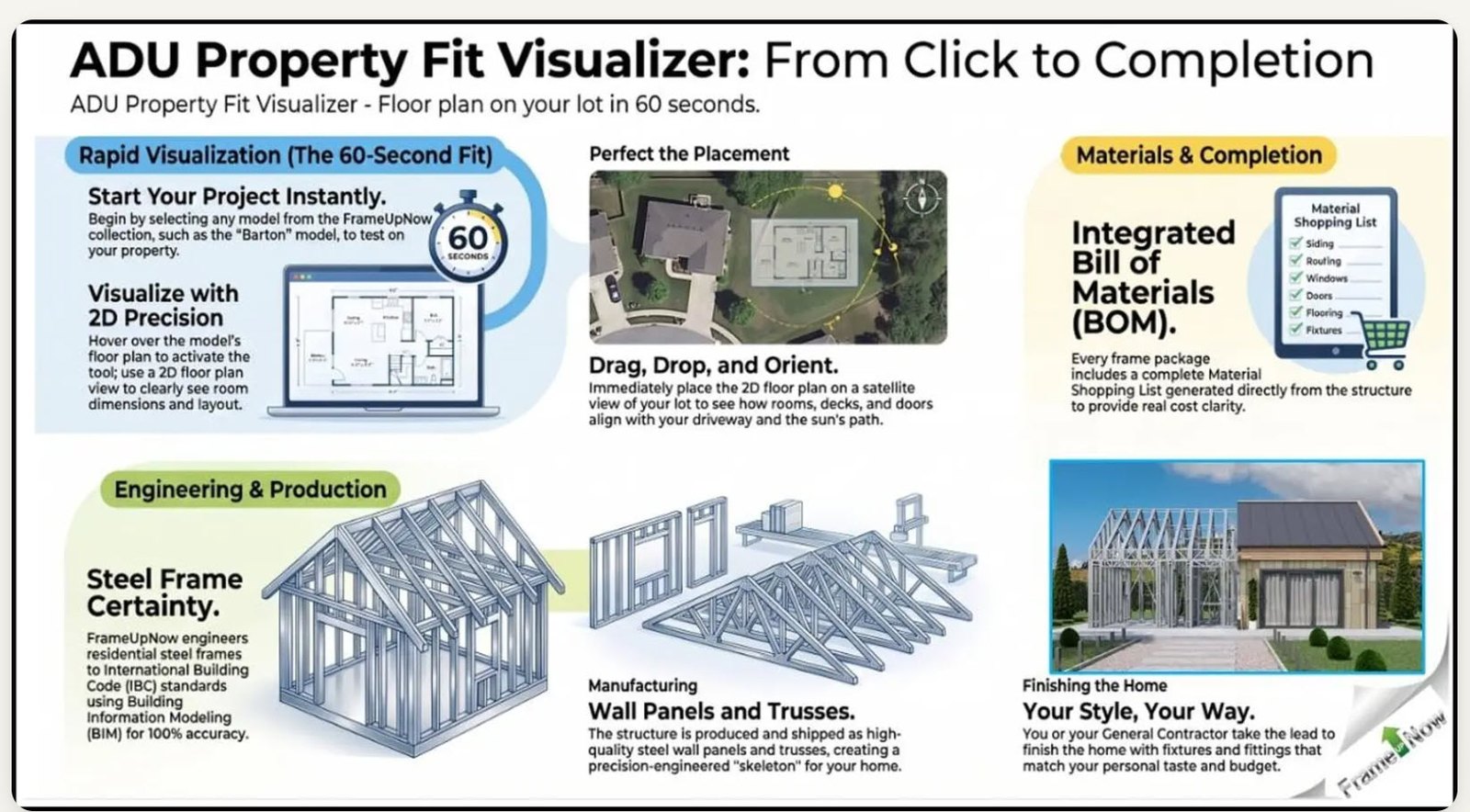
From click to completion: place a plan on your lot in about 60 seconds, see the full bill of materials, then order the engineered steel frame.
SEE IT BEFORE YOU SPEND A DOLLAR
Browse 5,000+ permit-ready plans at ADUplans.com and 208 engineered steel-frame models at FrameUpNow.com.
See the frame price and the full Home Depot bill of materials, every finishing part listed, so you can cost the whole home.
Place any plan on your own lot for free with the Plan Fit Visualizer. Here's how: Will an ADU fit on my lot?
DO THIS WEEK Walk your backyard and measure it. Most ADUs run 400 to 1,200 square feet. Then see which plans fit with the free Plan Fit Visualizer.
Frequently asked questions
Why are ADUs booming?
ADUs are booming because they add homes where the shortage hurts most, on lots that already have streets, water and power. According to Cotality, ADU permits rose about 1,100% from 2015 to 2025 and now make up about 7% of all U.S. residential permits. New federal and state laws, and thousands of free permit-ready plans, are speeding that growth in 2026.
What is an ADU?
ADU stands for accessory dwelling unit. An ADU is a small, complete home on the same lot as a house, with its own kitchen, bathroom and entrance. It's also called a granny flat, casita, in-law unit or backyard cottage. It can be detached, attached to the main house, or converted from a garage or other existing space.
How big is the U.S. housing shortage?
Estimates range from about 1 million to 10 million homes because they measure different things. In 2026 the White House Council of Economic Advisers estimated 10 million single-family homes, Zillow about 4.7 million, Realtor.com about 4 million, and John Burns Research and Consulting about 1 million.
How fast are ADUs growing?
According to Cotality building-permit data, ADU permits rose about 1,100% between 2015 and 2025, and ADUs now account for about 7% of all U.S. residential construction permits. In Los Angeles and San Francisco, more ADU permits were issued in 2025 than permits for every other kind of housing combined.
Which state builds the most ADUs?
California, by far. Cotality counts about 41,000 ADU permits there, roughly 52 for every 100 conventional home permits. Washington, Florida, Oregon, Arizona and Colorado follow.
How many ADUs are being built in Arizona?
Cotality counts about 1,600 ADU permits in Arizona, about 5 for every 100 conventional home permits, which ranks fifth in the country, just behind Oregon.
Can ADUs solve the housing shortage?
Not alone; nothing will. But ADUs are one of the few kinds of new homes that can be added one lot at a time in established neighborhoods, without new land, roads or utility lines, which is where homes are scarcest.
Can I build an ADU on my property?
Often, yes, but it depends on your state and city rules, your zoning, and your lot's size, setbacks and utility connections. Eighteen states now have statewide ADU laws that require cities to allow them in many single-family neighborhoods. Check with your city, and test real plans on your lot with FrameUpNow's free Plan Fit Visualizer.
Is a garage conversion an ADU?
It can be. A garage converted into a complete home with its own kitchen, bathroom and entrance is an ADU, and it needs the same permits as any other ADU. A garage turned into a bedroom or office without a kitchen is not.
How big can an ADU be?
Most ADUs run 400 to 1,200 square feet. The maximum depends on your state and city; many limits are tied to lot size or to a share of the main house's size, so check your local code before you choose a plan.
Sources
- PBS NewsHour / AP: The U.S. is short 10 million houses (April 2026)
- Inman: White House says 10 million, researchers disagree
- Chicago Agent: Zillow's 4.7 million home deficit
- Construction Owners: Realtor.com supply gap tops 4 million
- Cotality: Building backyard value with ADUs (permit data by state)
- Smart Cities Dive: Record ADUs in Los Angeles County
ABOUT THE AUTHOR
Rodger Ford is the Founder and CEO of FrameUpNow, which engineers cold-formed steel frames for permit-ready ADUs and homes, and of ADUplans.com, a library of 5,000+ permit-ready plans from jurisdictions across America. A Tucson entrepreneur for more than five decades, he founded AlphaGraphics in 1970, co-founded PetsHotel (later acquired by PetSmart), led the artificial-heart companies SynCardia and ReliantHeart, and co-authored a book with Michael Gerber. He spoke on engineering assurance in cold-formed steel housing at the 2026 CFSEI Expo.
Publisher's note: FrameUpNow sells cold-formed steel ADU frames and runs ADUplans.com. Plan and model counts are our own data. Permit figures come from Cotality, and shortage estimates from the sources listed. Laws and lending rules change often; confirm with your city and lender.