
The 5% Question: What Is the Cost of Building a Home That Is Easier to Insure?
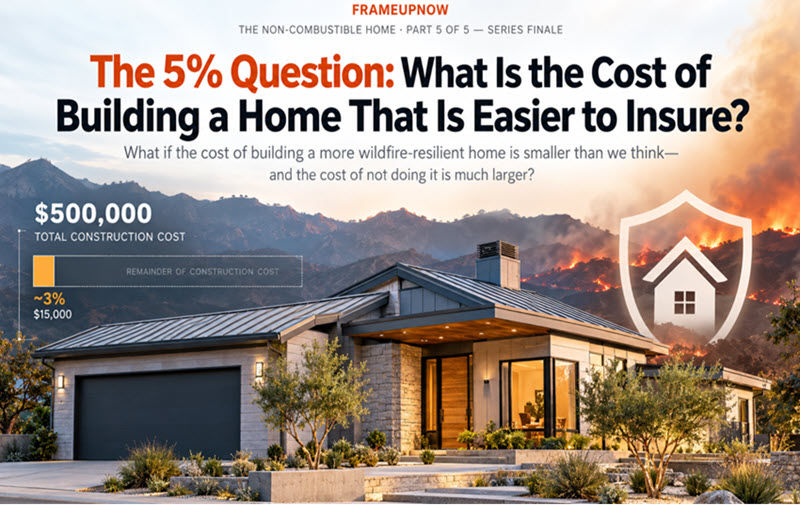
What if the cost of building a more wildfire-resilient home is smaller than we think—and the cost of not doing it is much larger?
We began this five-part series with a simple proposition:
We then asked what happens when the fuel is no longer a forest—but a subdivision. We examined the growing insurance consequences of wildfire. We defined what we mean by a non-combustible home. And we examined what happens when one burning house ignites the next.
Now we come to the economic question.
It may be the most important question of all:
WHAT DOES IT COST TO BUILD A HOME THAT IS EASIER TO INSURE?
The answer may be surprising.
THE 5% QUESTION
Let's begin with a number.
Five percent.
Suppose a new home costs $500,000 to construct. Five percent is $25,000.
Would a homeowner spend another $25,000 if doing so substantially reduced wildfire risk?
That is an interesting question. But there is a better question:
WHAT IF THE ACTUAL INCREMENTAL COST IS LESS THAN FIVE PERCENT?
That possibility is supported by recent research.
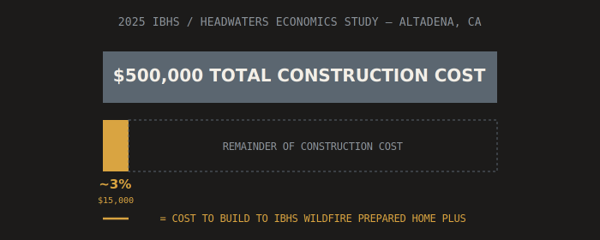
In 2025, the Insurance Institute for Business & Home Safety (IBHS) and Headwaters Economics analyzed the cost of constructing a 1,750-square-foot home in Altadena, California, to wildfire-resistant standards.
Their estimated total construction cost was $500,000.
They found that building to the IBHS Wildfire Prepared Home Plus standard added approximately $15,000 compared with traditional building methods—about 3% of the total estimated construction cost.
That is an important finding.
It does not prove that every wildfire-resilient home will cost only 3% more. It does not establish the cost of a complete non-combustible home. And it does not guarantee an insurance discount.
But it does challenge an assumption:
PERHAPS WILDFIRE RESILIENCE DOES NOT HAVE TO BE PROHIBITIVELY EXPENSIVE.
THE COST OF RESILIENCE IS NOT THE SAME AS THE COST OF REBUILDING
This distinction deserves attention.
A homeowner may look at a $15,000 or $25,000 construction premium and think: "That's expensive."
Now consider the alternative.
A catastrophic wildfire can destroy the entire structure. The homeowner may lose the house. The insurer may face a catastrophic claim. The community may lose hundreds or thousands of homes. The rebuilding process may take years. And the homeowner may have to find temporary housing while rebuilding occurs.
Suddenly, the incremental construction cost looks very different.
The economic comparison isn't simply:
$500,000 VERSUS $525,000.
it is
THE COST OF MITIGATION VERSUS THE COST OF CATASTROPHIC LOSS.
That is the economic conversation we need to have before the house is built—not after it burns.
THE INSURANCE EQUATION
Insurance exists to transfer risk. But insurance companies cannot eliminate risk. They price it.
And when an entire neighborhood can be destroyed by one wildfire, the potential loss becomes enormous.
That is why insurers are increasingly interested in mitigation.
California's Department of Insurance now requires insurers to provide discounts for qualifying wildfire mitigation actions, with reported discounts ranging from 4% to 40%, depending on the risk and the mitigation measures.
The state has also reported that some major insurers have committed to writing policies for homes meeting the IBHS Wildfire Prepared Home standard. And Travelers has announced increased discounts for mitigation measures including ember-resistant vents, Class A roofing and defensible space as part of its participation in California's Sustainable Insurance Strategy.
The message is becoming increasingly clear:
Insurance is beginning to recognize mitigation.
That doesn't mean every wildfire-resilient home receives a lower premium. It doesn't mean every insurer uses the same criteria. And it certainly doesn't mean a builder can promise a specific insurance savings.
But it means the construction of the house can increasingly become part of the conversation about risk.
WHAT IF THE PREMIUM ISN'T LOWER—BUT THE INSURANCE IS AVAILABLE?
This may be an even more important question.
Imagine two homes in a wildfire-prone community.

If both homes can obtain insurance at the same price, the homeowner may reasonably choose based on other factors.
But what if Home B is easier to insure? What if Home A faces a higher deductible? What if Home A has fewer coverage options? What if Home A becomes harder to insure as wildfire risk increases?
Then the difference between the two homes is no longer simply construction cost.
It becomes insurability.
California's Department of Insurance has explicitly connected wildfire mitigation with improved insurance availability and affordability. That may ultimately become one of the strongest arguments for resilient new construction.
THE REAL VALUE OF MITIGATION MAY BE INVISIBLE
There is something unusual about wildfire mitigation.
If it works, nothing happens.
The house doesn't burn. The homeowner doesn't file a claim. The insurance company doesn't pay hundreds of thousands of dollars. The neighborhood doesn't lose its homes.
That makes the value difficult to see.
A homeowner may look at a fire-resistant vent and ask:
"WHY SHOULD I SPEND MONEY ON THAT?"
The answer is:
BECAUSE THE VALUE OF THE VENT MAY BE MEASURED BY THE FIRE THAT NEVER GETS INTO THE HOUSE.
The same is true of a Class A roof. The same is true of protected eaves. The same is true of a noncombustible Zone 0. The same is true of fire-resistant windows. And potentially the same is true of a noncombustible structural system.
WHAT THE RESEARCH ACTUALLY TELLS US
We should be careful not to overstate the evidence.
The recent IBHS/Headwaters study did not say that every wildfire-resilient house costs 3% more.
It analyzed a specific 1,750-square-foot home in Altadena and specific wildfire-resistance measures. The study found that some of the most important wildfire-resistant building improvements added relatively little to new construction costs.
In fact, its detailed analysis found that building to the IBHS Wildfire Prepared Home Base level could cost less than the California Wildland-Urban Interface Code comparison used in the study, while the Plus level added approximately $2,000 over that code baseline for the particular building components analyzed.
That is fascinating.
It suggests that the cost of wildfire resilience depends heavily on what standard you are comparing against and when the improvements are incorporated.
New construction is therefore particularly important. It is generally less expensive to incorporate resilience during construction than to retrofit it afterward.
THE 5% QUESTION MAY BE THE WRONG QUESTION
We began with:
"WHAT IF A NONCOMBUSTIBLE HOME COSTS 5% MORE?"
After examining the research, perhaps we should ask a different question:
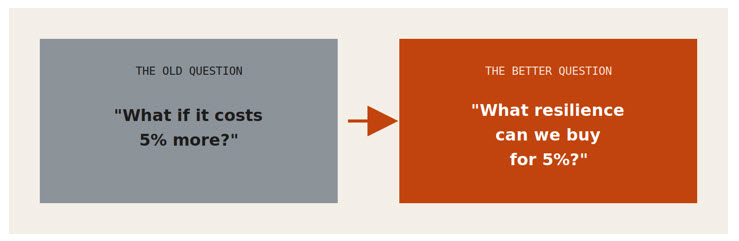
Maybe the answer is: a better roof, better windows, protected eaves, ember-resistant vents, a noncombustible Zone 0, fire-resistant decks, better exterior materials—and perhaps, depending on the design and location, a substantially more noncombustible structural system.
The exact answer needs to be determined project by project. But the principle is powerful.
WHERE COLD-FORMED STEEL CHANGES THE EQUATION
This is where FrameUpNow® enters the discussion.
The IBHS/Headwaters study does not establish the cost or insurance impact of a complete cold-formed steel/noncombustible home. We should be very clear about that.
But it does establish something important:
WILDFIRE-RESILIENT CONSTRUCTION CAN BE ECONOMICALLY PRACTICAL.
Cold-formed steel offers another opportunity. Steel framing is noncombustible. If the structural system can be combined with noncombustible sheathing, noncombustible insulation and appropriately designed exterior assemblies, the amount of combustible material in the building system can be reduced.
That is the concept we explored in Article #3... What Is a Non-Combustible Home?
And now the economic question becomes:
WHAT WOULD IT COST TO MOVE FROM A WILDFIRE-RESISTANT HOME TO A SUBSTANTIALLY NONCOMBUSTIBLE HOME?
That question deserves a serious cost study. Not a sales pitch. A study.
THE MISSING NUMBER
We now have useful research on the cost of wildfire-resistant construction. But there is still a number the industry needs:
The cost of a complete noncombustible home.
Not just the roof. Not just the siding. Not just the vents. Not just the windows. The entire system.
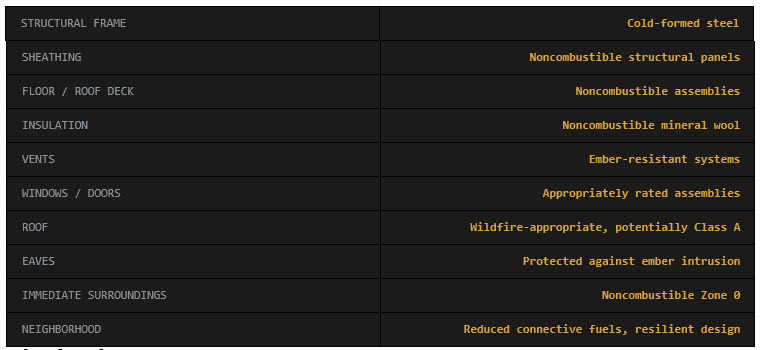
What does that cost?
That is a question FrameUpNow® could help answer.
THE DEVELOPER'S 5% QUESTION
The question becomes even more interesting when we stop thinking about one house.
Imagine a developer planning 200 homes. The developer has two choices.

Option B may cost more. But it may also produce:
● Lower expected wildfire loss
● Potentially improved insurability
● Potential insurance benefits where recognized by carriers
● Greater buyer confidence
● Potentially greater long-term marketability
● A more resilient community
And perhaps something else:
A marketable difference.
A developer could potentially tell a buyer:
"THIS ISN'T JUST ANOTHER SUBDIVISION. IT WAS DESIGNED TO REDUCE WILDFIRE RISK."
That is a very different value proposition.
COULD RESILIENCE BECOME A SELLING POINT?
Homebuilders already market energy efficiency, smart-home technology, solar power, Energy Star appliances, high-performance windows and low-maintenance materials.
Why not wildfire resilience?
A future buyer may understand the value of ember-resistant vents, a noncombustible Zone 0, a Class A roof, noncombustible exterior materials, steel structural framing and a wildfire-prepared neighborhood.
The challenge is certification. Buyers need to know what the claim means.
That is why third-party standards such as the IBHS Wildfire Prepared Home and Wildfire Prepared Neighborhood programs are important. IBHS's current program provides science-based requirements and third-party verification, and in 2026 expanded its framework to include neighborhoods and multifamily properties.
The future may not be about simply saying:
"THIS HOUSE IS FIRE RESISTANT."
it may be about demonstrating
"THIS HOUSE MEETS A RECOGNIZED WILDFIRE-RESILIENCE STANDARD."
THE HOMEOWNER'S EQUATION
A homeowner doesn't live in a spreadsheet. They live in the house.
They want to know: will my family be safe? Will my house survive? Can I insure it? Can I afford the insurance? Will someone want to buy it later? Will my neighborhood remain insurable?
Those questions are becoming connected. And that means the traditional definition of home affordability may have to change.
THE NEW DEFINITION OF AFFORDABLE HOUSING
Perhaps an affordable home is not simply a home that costs less to build.
Perhaps it is a home that costs less to own over time.
That means considering construction, insurance, maintenance, energy, resilience, replacement risk—and ultimately, insurability.
If spending a few additional percentage points during construction can materially reduce wildfire risk and improve the home's insurance position, the economics deserve to be examined.
The cheapest house may not be the most affordable house.
WE SHOULD TEST THE PROPOSITION
This is where FrameUpNow® should be cautious—and ambitious.
WHAT WE SHOULD NOT SAY
"A noncombustible home will cost only 5% more." We don't have sufficient evidence to make that claim.
"A steel-framed home will have a lower insurance premium." That depends on the insurer, location, policy and recognized mitigation measures.
"A noncombustible home cannot burn." No building should be marketed that way.
Instead, we should ask the industry to do something more useful:
That is a legitimate research question. And it is one worth answering.
THE 5% QUESTION BECOMES THE 50-YEAR QUESTION
A house may exist for half a century or longer. So perhaps the right economic horizon isn't:
WHAT DOES IT COST TODAY?
it is
WHAT DOES IT COST OVER 50 YEARS?
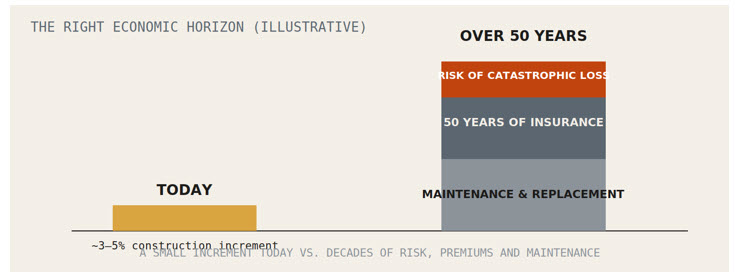
We don't know the answer for every house. But we can calculate it. And we should.
THE FUTURE OF HOUSING MAY BE MEASURED IN RISK-ADJUSTED COST
For decades, builders have competed primarily on cost per square foot.
Perhaps the next generation will also compete on risk per square foot.
How much combustible material? How much wildfire exposure? How much insurance risk? How much resilience? How much expected loss?
Those questions may eventually become as important to buyers as countertops and floor plans.
THE FIVE-PART SERIES COMES FULL CIRCLE
We began this series with a forest.
Fire follows fuel.
WHAT DOES IT COST TO BREAK THE CHAIN?
Perhaps the answer is not as expensive as we once thought.
Perhaps the real question is not:
"WHY SHOULD WE SPEND MORE TO BUILD DIFFERENTLY?"
perhaps it is
"HOW MUCH ARE WE WILLING TO SPEND TODAY TO REDUCE THE RISK OF LOSING EVERYTHING TOMORROW?"
BUILD FOR THE NEXT 50 YEARS
FrameUpNow® believes the conversation about wildfire-resilient housing should move beyond fear.
It should move toward design. Toward engineering. Toward measurable mitigation. Toward better economics. And toward a new definition of affordability.
The objective isn't to promise a house that can never burn. The objective is to build a house that gives fire fewer opportunities to ignite it—and a neighborhood that gives fire fewer opportunities to spread.
The evidence is beginning to show that meaningful wildfire resilience can be achieved without making new homes economically impractical.
Now the industry needs to take the next step.
● What would it cost to build the substantially noncombustible home?
● What would it cost to build an entire subdivision that works as a passive firebreak?
● And what would the insurance industry do with that information?
Those questions are waiting to be answered.
Perhaps the five-percent question isn't really about five percent at all.
IT IS ABOUT WHAT WE ARE WILLING TO INVEST TODAY TO MAKE THE AMERICAN HOME SAFER, MORE RESILIENT AND POTENTIALLY MORE INSURABLE FOR THE NEXT FIFTY YEARS.
BUILD IT ONCE. BUILD IT FOR THE ENVIRONMENT IN WHICH IT WILL LIVE. AND BUILD IT WITH THE FUTURE COST OF RISK IN MIND.