

STRUCTO-CRETE® vs. MAXTERRA® vs. Megaboard
The Next Step Beyond a Noncombustible Steel Skeleton
Cold-formed steel changes an important part of residential construction. Instead of building a home's structural skeleton from combustible lumber, cold-formed steel — CFS — allows walls, floor systems, and roof framing to be engineered from dimensionally stable, noncombustible steel.
But that raises an interesting question:
If the structural skeleton is noncombustible, why automatically cover it with combustible plywood or OSB structural sheathing?
For conventional construction, OSB and plywood remain useful, familiar, and economical structural products. But builders, architects, and homeowners interested in greater fire resilience now have additional options. Three products of particular interest:
● USG STRUCTO-CRETE® Structural Wall Panels
● NEXGEN MAXTERRA® MgO Non-Combustible Structural Wall Sheathing
● Ectek Megaboard Non-Combustible Structural Wall Sheathing
All three are structural sheathing products intended to perform functions beyond merely enclosing a wall. All three offer noncombustible alternatives to traditional wood structural sheathing. And all three raise a larger question for the residential construction industry:
Can the noncombustible steel skeleton and the structural sheathing be engineered together as one integrated noncombustible structural wall system?
For FrameUpNow, that is the real subject of this comparison.
What Is Structural Sheathing?
Structural sheathing does far more than cover the outside of a wall. When properly engineered and attached, it works with the studs, tracks, fasteners, anchors, hold-downs, and other structural components to resist loads imposed on the building. Depending on the engineered assembly, structural sheathing can contribute resistance to wind pressure, wind suction, lateral loading, wall racking, and seismic forces — in other words, it helps transform individual framing members into an engineered structural wall.
There is a significant difference between:
a panel installed over a structural wall
and
a panel engineered as part of the structural wall.
For FrameUpNow, the second opportunity is considerably more interesting.
What Is STRUCTO-CRETE?
STRUCTO-CRETE is a glass-fiber-reinforced cementitious structural panel manufactured by USG. USG's 1/2-inch STRUCTO-CRETE Structural Wall Panel is specifically intended for structural wall applications and is marketed as an alternative to materials including OSB, gypsum sheathing, and fire-retardant-treated wood. USG identifies noncombustibility, shear and wind-load capacity, impact resistance, dimensional stability, and fire-rated construction among the panel's primary attributes.
The manufacturer states that its 1/2-inch structural wall panel can be used in low-rise and single-family residential construction as well as larger commercial applications. Most importantly for FrameUpNow, USG publishes engineering information showing STRUCTO-CRETE used with cold-formed steel framing — and goes so far as to state that, in properly engineered assemblies, its structural wall panel can replace certain CFS cross-bracing requirements.
That deserves attention because the economic comparison may involve more than replacing one sheet product with another. STRUCTO-CRETE could potentially become part of the structural engineering of the FrameUpNow wall itself.
What Is MAXTERRA?
MAXTERRA is a magnesium-oxide (MgO) structural panel produced by NEXGEN Building Products. One point needs to be stated clearly: MAXTERRA is structural sheathing. It should not be characterized merely as a fire-resistant covering or exterior board.
The applicable ICC-ES evaluation report recognizes MAXTERRA panels for use as structural wall sheathing, with allowable transverse wind loads and shear-resistance provisions under the conditions it covers. NEXGEN specifically markets MAXTERRA Structural Sheathing for cold-formed steel construction. Its March 2026 CFS technical playbook describes the product as noncombustible structural sheathing for light-gauge steel exterior and interior walls, structurally rated for wind and shear at framing spacing up to 24 inches on center — which makes it particularly relevant to FrameUpNow.
One Important MAXTERRA Engineering Distinction
There is an important technical distinction between manufacturer application literature and the explicit scope of a code-evaluation report. The current ESR-5193 clearly recognizes MAXTERRA as structural wall sheathing, but the shear-wall installation provisions visible in that report specify wood framing members for the tabulated shear-wall application. NEXGEN's newer technical materials expressly promote MAXTERRA for CFS walls and describe it as structurally rated for wind and shear, and the company states elsewhere that MAXTERRA has ICC-ES certification supporting CFS and wood-frame construction.
These statements should not be casually combined into an engineering conclusion. For FrameUpNow, the proper course is simple: obtain the CFS-specific MAXTERRA wall test reports, fastening schedules, and allowable design values directly from NEXGEN before relying on the panel as a standardized FrameUpNow CFS shear-wall element. That does not diminish MAXTERRA — it is simply good engineering.
What Is Megaboard?
Megaboard is a noncombustible structural building panel produced by Ectek Building Materials. Ectek describes it as an inorganic cementitious panel reinforced with a six-layer fiberglass mesh, offered as 1/2-inch and 5/8-inch wall sheathing and as a 3/4-inch subfloor panel, and markets it for use in place of plywood, OSB, gypsum sheathing, and lightweight concrete pours. Ectek specifically targets light-gauge steel modular construction and the CFS construction of low- to mid-rise buildings. The panel is mechanically fastened directly to steel (screwed) or wood (nailed) framing and is cut with standard carbide-tipped tools.
What makes Megaboard immediately interesting for FrameUpNow is how much CFS structural data Ectek places directly on its wallboard submittal sheet. For 5/8-inch Megaboard, single-sided, over 50 ksi, 54-mil cold-formed steel studs with No. 8 screws and no stud blocking, Ectek lists nominal shear strengths of 3,561 plf for wind and 3,711 plf for seismic at 2-inch edge / 12-inch field screw spacing, and 1,540 plf (wind) and 1,605 plf (seismic) at 6/12 spacing, at a maximum 4:1 aspect ratio. The 1/2-inch panel on the same CFS framing is listed at 1,194 plf (wind) and 1,501 plf (seismic) at 2/12 spacing. Ectek's recommended design factors are ASD Ω = 2.0 and LRFD Φ = 0.65 for wind, and ASD Ω = 2.5 and LRFD Φ = 0.60 for seismic.
Ectek also publishes a 2-hour fire-rated, load-bearing wall assembly on CFS framing: 5/8-inch Megaboard on both sides of minimum 3-5/8-inch C-studs at 16 inches on center, with ROCKWOOL ThermalRock S100 insulation boards in the cavity and No. 8 self-drilling screws at 6 inches on center for the fire rating. For that assembly Ectek lists ASD shear values of 3,186 plf (wind) and 2,548 plf (seismic) at 2/6 fastening, seismic design coefficients of R = 6.5, Ω₀ = 3, and Cd = 4, and a 65-foot height limit in Seismic Design Category D, referencing IAPMO UES ER-710 for assembly and installation requirements.
Megaboard Documentation: What to Verify
As with MAXTERRA, the right approach is to separate what the manufacturer publishes from what a code-evaluation report currently covers. Ectek's brochure and wallboard specification list Megaboard as IAPMO certified and listed as noncombustible for all types of noncombustible construction, but the same documents describe the 2-hour wall assembly as “tested with Intertek, certification pending” and the shear wall as “certification pending with IAPMO.” The newer 2-hour wall flyer points to IAPMO UES ER-710 and notes that additional testing is underway to evaluate higher structural capacities.
There is also a framing detail worth confirming. The wallboard specification calls for metal framing of at least 20 gauge, spaced no more than 24 inches on center, with a minimum 1-5/8-inch flange and low-profile fasteners on the supporting flange. The published shear values were developed on 54-mil (16-gauge) studs, while the 2-hour assembly lists studs with a 0.0472-inch base-metal thickness. FrameUpNow should obtain the current ER-710 report, confirm its issue date and exactly which shear and fire-resistance values it covers, and confirm the minimum stud thickness for its own CFS wall system before treating Megaboard as a standardized FrameUpNow shear-wall element. That is not a criticism of Megaboard — it is simply good engineering.
All Three Products Are Noncombustible
This is one of the most important similarities. ASTM E136 is used to assess whether a building material satisfies the criteria used to classify it as noncombustible; materials passing the test typically do not significantly aid combustion or add appreciable heat to an ambient fire. MAXTERRA is classified as a noncombustible building material in its ICC-ES evaluation report, USG likewise identifies STRUCTO-CRETE as a noncombustible structural panel, and Ectek reports that Megaboard passed ASTM E136, is IAPMO listed as noncombustible, and carries a Class A (0 flame spread / 0 smoke-developed) surface-burning rating under UL 723.
That creates a fundamentally different wall concept:
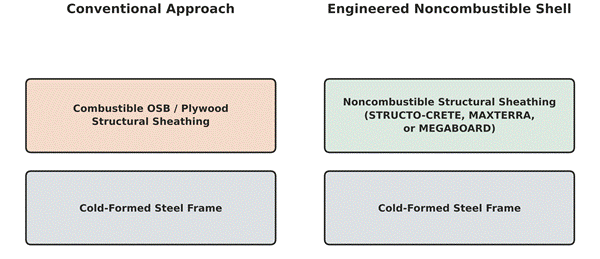
Cold-formed steel framing + noncombustible structural sheathing
instead of:
Cold-formed steel framing + combustible wood structural sheathing.
This does not create a “fireproof” home — no responsible manufacturer should make that claim. Wildfire resilience also depends on roof coverings, exterior cladding, vents, eaves, windows, doors, decks, vegetation, ember entry, radiant heat exposure, and many other details. But reducing combustible material in the structural shell is nonetheless meaningful.
STRUCTO-CRETE's CFS Engineering Advantage
One of STRUCTO-CRETE's current advantages is the depth of publicly available CFS engineering documentation. USG's evaluation documentation addresses structural applications over cold-formed steel framing and describes systems resisting gravity, wind, and seismic loads, including CFS wall-racking configurations with capacities that vary by panel orientation, one- or two-sided installation, and fastener spacing. That gives a FrameUpNow structural engineer specific published data to begin evaluating STRUCTO-CRETE as part of a CFS wall assembly — though the complete wall configuration, including stud thickness, spacing, height, openings, anchors, fasteners, and loading, still has to be engineered.
MAXTERRA's Potential Advantage
MAXTERRA approaches the problem differently and deserves serious evaluation. NEXGEN is actively targeting cold-formed steel construction, and its current CFS literature presents MAXTERRA as a structural wall product rather than merely a protective covering. MAXTERRA also offers useful dimensional options and potentially lower panel weight — characteristics that could make it particularly attractive for panelized residential construction.
The remaining question is not whether MAXTERRA is structural — it is. The question is what exact CFS shear values, fastener schedules, and engineering conditions FrameUpNow's engineer can use for the particular FrameUpNow wall system. Once NEXGEN answers that, the comparison becomes much more complete.
Megaboard's Potential Advantage
Megaboard brings a different combination to the table. Ectek publishes CFS shear-wall values developed without stud blocking directly on its submittal sheet and pairs that structural data with a published 2-hour load-bearing CFS wall assembly — an attractive combination for a builder pursuing a noncombustible structural shell. At 5/8 inch it is also lighter than the comparable MAXTERRA panel, and Ectek reports very low moisture movement (0.01% thickness swelling after 24-hour water immersion in testing), mold resistance per ASTM G21, and resistance to termites.
Megaboard also extends beyond the wall. Ectek's 3/4-inch Megaboard Subfloor appears in more than 30 UL fire-resistance-rated floor/ceiling and roof assemblies of up to 2 hours — including assemblies over cold-formed steel C-joists and light-gauge steel trusses — which is directly relevant to the larger goal of a home whose floors and roof deck, not just its walls, are noncombustible. Ectek also lists State of California (Cal-Fire) approval. The open items are the certification status and framing scope described above; once Ectek confirms them, Megaboard becomes a fully comparable contender.
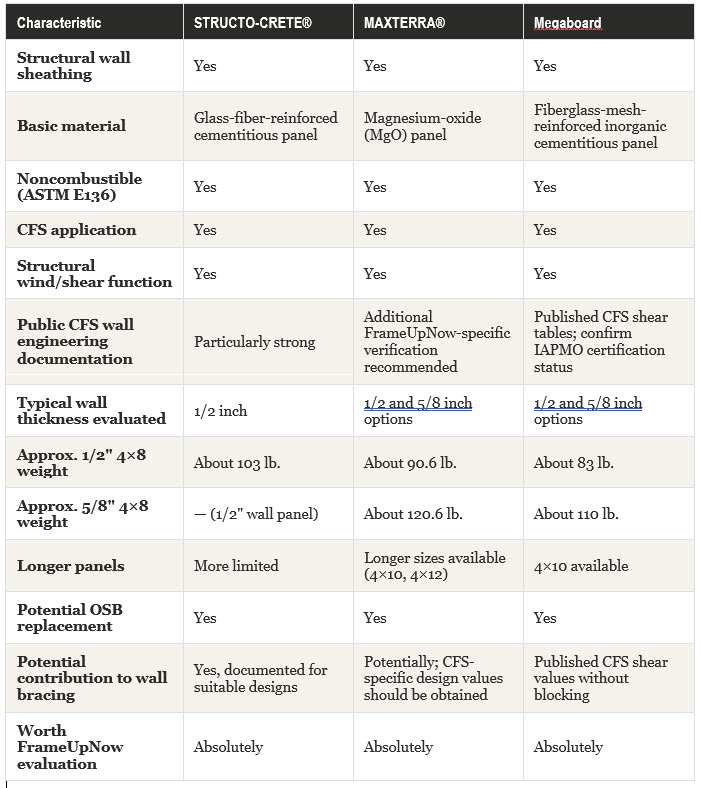
STRUCTO-CRETE vs. MAXTERRA vs. Megaboard at a Glance
Weight: An Important Difference
Structural performance is only part of the equation. Weight matters enormously in a manufacturing operation — it affects transportation, unloading, material movement, factory assembly, finished wall-panel weight, outbound freight, and jobsite erection.
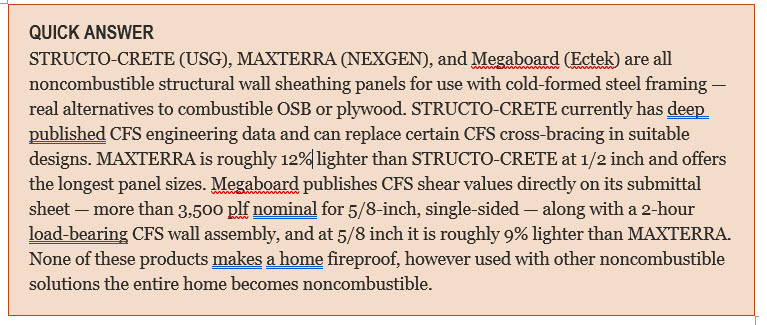
Using current published product data for 1/2-inch material, a 4×8 STRUCTO-CRETE wall panel weighs approximately 103 pounds. MAXTERRA's published 1/2-inch weight of approximately 2.83 pounds per square foot produces a calculated 4×8 panel weight of approximately 90.6 pounds — about 12.4 pounds less per sheet, or roughly 12% lighter.
At 5/8 inch, the comparison shifts to MAXTERRA and Megaboard. Ectek publishes a 5/8-inch 4×8 Megaboard weight of about 110 pounds (3.45 pounds per square foot), while NEXGEN's published 5/8-inch MAXTERRA weight of about 3.77 pounds per square foot works out to roughly 120.6 pounds per 4×8 sheet — making Megaboard about 10.6 pounds, or roughly 9%, lighter at that thickness. STRUCTO-CRETE's structural wall panel is compared here at 1/2 inch only, and Ectek's current submittal sheet does not list a 1/2-inch Megaboard weight. These differences may sound modest until they are scaled to an entire project.
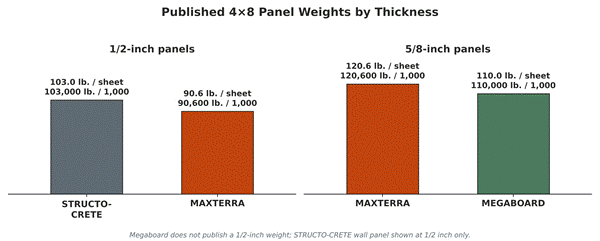
Figure 2 — Published 4×8 panel weights by thickness; small per-sheet differences compound quickly at production volume.
At approximately 103 pounds each, 100 STRUCTO-CRETE sheets weigh roughly 10,300 pounds; 100 MAXTERRA sheets weigh roughly 9,060 pounds — a difference of about 1,240 pounds, or more than half a ton, disappearing from the material-handling equation for every 100 sheets. Scaled to 1,000 sheets, the gap grows to roughly 12,400 pounds — more than six tons. At 5/8 inch, 100 Megaboard sheets weigh roughly 11,000 pounds versus about 12,060 pounds for MAXTERRA — a gap of about 1,060 pounds per 100 sheets, or more than five tons per 1,000 sheets. For FrameUpNow, that weight can potentially be transported twice: manufacturer to FrameUpNow factory, and — if panels are factory-sheathed — factory to jobsite.
Consider a typical 8-foot-high by 12-foot-long FrameUpNow wall requiring approximately three 4×8 sheets: STRUCTO-CRETE sheathing runs about 309 pounds versus about 272 pounds for MAXTERRA — a difference of about 37 pounds on one wall panel. Sheathed with 5/8-inch panels, the same wall would carry about 330 pounds of Megaboard or about 362 pounds of MAXTERRA. Multiply that across every exterior wall of a home and it becomes a meaningful manufacturing and logistics consideration.
Longer Panels May Create Another Advantage
MAXTERRA is available in longer dimensions in applicable product configurations. At approximately 2.83 pounds per square foot, theoretical panel weights run about 91 pounds (4×8), 113 pounds (4×10), and 136 pounds (4×12). Megaboard is also offered as a 5/8-inch 4×10 panel, which Ectek lists at about 135 pounds. Longer panels may reduce horizontal joints, which could mean fewer fasteners, less blocking, cleaner wall assemblies, and simpler factory production.
But there is a tradeoff: a 136-pound 4×12 panel is difficult to handle manually in the field. That may actually strengthen the argument for factory panelization — FrameUpNow can design the manufacturing process around mechanical material handling rather than requiring field crews to wrestle heavy panels into position.
Now Consider Cost
Cost is the most tempting — and easiest — part of this comparison to oversimplify. A buyer might naturally ask what a sheet of STRUCTO-CRETE, MAXTERRA, Megaboard, or OSB costs. But those four numbers do not answer the important question. Project pricing for these specialized structural products varies by distributor, quantity, freight, geography, and purchasing agreement, and the manufacturers themselves direct prospective buyers toward representatives or distribution channels rather than a universal OEM price. Publishing an arbitrary internet sheet price would create false precision.
Compare the Wall, Not the Sheet
Suppose a noncombustible structural panel costs substantially more than OSB. At first glance, OSB wins. But what if the structural panel also allows the engineer to eliminate or reduce diagonal CFS bracing, structural straps, blocking, additional connectors, additional fasteners, fabrication operations, or installation labor? The economic conclusion could change dramatically. USG specifically says its STRUCTO-CRETE structural wall panels can replace CFS cross bracing in appropriate designs, and Ectek's published CFS shear values — developed without stud blocking — raise the same question for Megaboard. That means the comparison should not be sheet vs. sheet. It should be existing FrameUpNow wall vs. STRUCTO-CRETE-engineered wall vs. MAXTERRA-engineered wall vs. Megaboard-engineered wall.
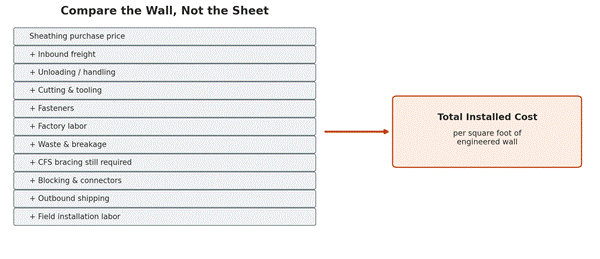
The end user customer should request comparable OEM quotations from USG, NEXGEN, and Ectek, covering 100 sheets, 500 sheets, 1,000 sheets, full truckload quantities, and projected annual volume — including sheet price, square-foot price, pallet quantity and weight, truckload capacity, freight, volume discounts, lead times, fastener requirements, and recommended tooling. That moves the purchasing decision from general internet research to actual FrameUpNow manufacturing economics.
Could a More Expensive Sheet Produce a Less Expensive Wall?
Absolutely — and that possibility is the most important economic insight from this study. A structural sheathing panel can potentially perform several functions simultaneously: structural enclosure, shear resistance, wind resistance, noncombustibility, moisture resistance, mold resistance, and impact resistance. If one panel performs multiple functions and eliminates other components or labor, its sheet price becomes far less meaningful. A more expensive sheet could conceivably create a less expensive wall — which is why engineering must precede purchasing.
STRUCTO-CRETE, MAXTERRA, or Megaboard: Which Is Better?
At this stage, there is no responsible basis for declaring a universal winner. STRUCTO-CRETE presently has an important advantage: clearly accessible CFS structural-wall documentation and a manufacturer explicitly promoting the reduction of CFS cross bracing in appropriate engineered assemblies. MAXTERRA has several potentially meaningful advantages: lower weight in the comparable 1/2-inch panel, longer panel options, MgO technology, aggressive development for CFS applications, and the potential for efficient factory panelization. Megaboard adds a third profile: CFS shear-wall values published directly on its submittal sheet, a published 2-hour load-bearing CFS wall assembly, a lighter 5/8-inch panel than MAXTERRA, and a companion subfloor panel with an extensive list of UL-rated floor/ceiling and roof assemblies — with its certification status and minimum framing requirements still to be confirmed.
The Question Has Changed
For decades, residential construction has asked: should we frame the house in wood or steel? Perhaps the better question is becoming: how much combustible structural material needs to be in the house at all? Cold-formed steel addresses the skeleton. Noncombustible structural sheathing can extend that concept outward. That does not make a home fireproof, but it creates another tool for engineering more resilient residential construction.
The Principle
The eventual decision among STRUCTO-CRETE, MAXTERRA, and Megaboard should not be based on brand preference. It should be based on engineering. The winner is the system that provides the best combination of structural certainty, noncombustibility, manufacturing efficiency, lower installed cost, manageable weight, efficient transportation, and documented performance — plus a simpler, better engineered wall.
The ultimate measurement should therefore be:
Dollars Per Square Foot of Completed Engineered Noncombustible Structural Shell — not dollars per sheet.
And that leads to a simple idea:
Build the Skeleton in Steel. Build the Structural Shell Noncombustible.
Frequently Asked Questions
Q1. Is MAXTERRA actually structural sheathing?
Yes. MAXTERRA is evaluated and marketed as structural wall sheathing. The important question for a FrameUpNow CFS application is not whether it is structural, but what specific CFS fastening schedules, shear values, and design conditions apply to the particular engineered wall.
Q2. Is STRUCTO-CRETE structural sheathing?
Yes. USG's 1/2-inch STRUCTO-CRETE Structural Wall Panel is designed for structural wall applications and has published information for cold-formed steel construction, including wind and shear applications.
Q3. Is Megaboard structural sheathing?
Yes. Ectek markets 1/2-inch and 5/8-inch Megaboard as noncombustible structural wall sheathing for steel and wood framing and publishes nominal shear strengths for both thicknesses on cold-formed steel studs. Ectek's literature describes IAPMO shear-wall certification as pending, while its 2-hour wall flyer references IAPMO UES ER-710, so FrameUpNow should confirm the current report and its scope before relying on those values.
Q4. Can these products replace OSB?
All three are positioned for applications where they can replace conventional structural sheathing such as OSB, subject to the engineering, assembly, building-code, and manufacturer requirements applicable to the project.
Q5. Which product is lighter?
Based on currently published data, 1/2-inch MAXTERRA at approximately 2.83 pounds per square foot produces a calculated 4×8 weight of about 90.6 pounds. A comparable 1/2-inch STRUCTO-CRETE 4×8 wall panel is approximately 103 pounds. MAXTERRA is therefore about 12 pounds, or roughly 12%, lighter per comparable sheet. At 5/8 inch, Megaboard is published at about 110 pounds per 4×8 sheet (3.45 pounds per square foot) versus a calculated 120.6 pounds for 5/8-inch MAXTERRA (3.77 pounds per square foot), making Megaboard roughly 9% lighter at that thickness. Ectek's current submittal sheet does not list a 1/2-inch Megaboard weight.
Q6. Which product costs less?
A dependable universal answer is not available from public pricing. Commercial quantities, freight, project location, and OEM purchasing agreements materially affect cost. FrameUpNow should obtain comparable manufacturer quotations and calculate total installed wall cost rather than comparing retail sheet prices.
Q7. Can structural sheathing eliminate steel bracing?
Potentially. The answer depends on the engineered wall assembly. USG specifically identifies applications in which STRUCTO-CRETE can replace CFS cross bracing. FrameUpNow would need its structural engineer to determine exactly what bracing could be eliminated for each wall configuration. MAXTERRA should likewise be evaluated using CFS-specific structural design data supplied by NEXGEN. Ectek publishes nominal CFS shear values for Megaboard developed without stud blocking, which FrameUpNow's engineer can use as a starting point once the current IAPMO certification scope is confirmed.
Q8. Does noncombustible sheathing make a home fireproof?
No. Noncombustible framing and sheathing can reduce combustible materials in the structural shell, but wildfire performance depends on the entire building system, including roofs, windows, doors, vents, cladding, decks, ember protection, and surrounding vegetation.
Q9. Why might factory installation make sense?
All three structural panel products are relatively heavy. Factory handling equipment can make moving, positioning, cutting, and fastening them much easier than field installation. Factory sheathing may also provide more controlled fastening, improved quality assurance, and reduced jobsite labor.
Q10. What is the best way to compare STRUCTO-CRETE, MAXTERRA, Megaboard, and OSB?
The correct measurement is total installed cost per square foot of engineered wall.
Technical and Supplier References
USG Corporation — STRUCTO-CRETE® Brand Structural Wall Panels. Manufacturer specifications, applications, and technical documentation for the 1/2-inch structural wall panel.
USG Corporation — STRUCTO-CRETE® Structural Panels product family, including wall, subfloor, and roof-deck configurations.
ICC-ES ESR-1792 — USG STRUCTO-CRETE Structural Panels. Evaluation information addressing structural applications and framing systems.
NEXGEN Building Products — MAXTERRA® MgO Non-Combustible Structural Wall Sheathing. Manufacturer technical and application information.
NEXGEN Building Products — Product overview for the full MAXTERRA MgO panel line, including structural floor panels.
ICC-ES ESR-5193 — MAXTERRA Structural Wall Sheathing. Evaluation information covering structural wall sheathing, wind resistance, shear resistance, and noncombustibility.
ICC-ES ESR-5194 — MAXTERRA MgO Non-Combustible Single-Layer Structural Floor Panels.
NEXGEN Building Products — Panels on Cold-Formed Steel, Version 1.1, March 2026. Technical guidance describing MAXTERRA structural sheathing in light-gauge steel construction.
Ectek Building Materials — Megaboard. Brochure: The Non-Combustible Structural Building Panel for Subfloor and Wall Sheathing Applications.
Ectek Building Materials — Megaboard Wallboard Product Submittal Sheet. Framing and fastener requirements, installation guidance, nominal shear strength tables, and technical data.
Ectek Building Materials — Megaboard Assembly: 2 HR Fire Rated Load Bearing Wall. Wood and CFS assembly details with ASD shear values and seismic design coefficients.
IAPMO UES ER-710 — referenced by Ectek for Megaboard assembly and installation requirements.
Intertek Report #200527009SHF-002 — ASTM E119 fire-resistance test, 5/8-inch Megaboard each side of 3-5/8-inch steel studs (2 hours).
Ectek Building Materials — Megaboard Subfloor UL Listed Assemblies Product Submittal Sheet (2025). UL floor/ceiling and roof assemblies using 3/4-inch Megaboard.
ASTM International — ASTM E136. Standard Test Method for Assessing Combustibility of Materials Using a Vertical Tube Furnace at 750°C.