
DIY Steel Frame Home Kits vs. Wood: Which Is Better?
.avif)
For an owner-builder, choosing the structural framing system is one of the most important early decisions.
Both wood and cold-formed steel can be used successfully for residential construction, but DIY steel frame home kits offer distinct advantages for builders who value precision, dimensional stability, durability and an engineered approach to assembly.
An owner-builder may also be able to reduce some labor and general-contractor costs by completing portions of the project personally or with help from experienced friends, family members and subcontractors.
FrameUpNow provides engineered cold-formed steel framing systems designed to help move a project from architectural plans to a manufactured structural frame.
What Is a DIY Steel Frame Home Kit?
A DIY steel frame home kit provides the structural steel skeleton of a building—not a completely finished home.
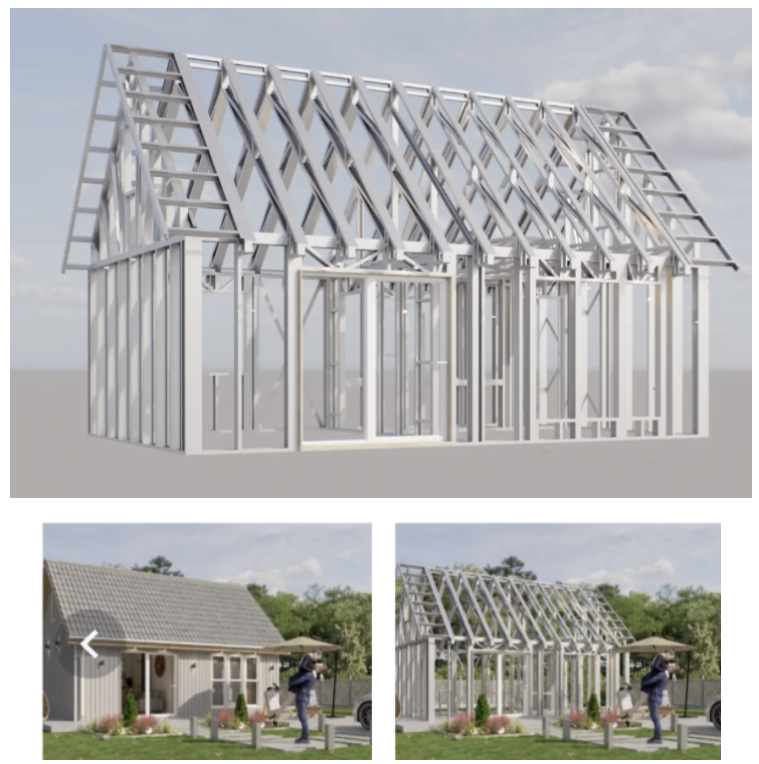
Cold-formed steel, often called CFS or light-gauge steel framing, is manufactured from structural-quality sheet steel formed into structural members such as studs, tracks and joists. BuildSteel's guide to cold-formed steel framing provides additional information about how CFS is manufactured and used in construction.
Depending on the building design, a FrameUpNow structural framing package can include:
- Wall framing
- Floor framing where applicable
- Roof trusses
- Joists
- Beams
- Headers
- Other engineered structural components
With FrameUpNow, the structural framing is engineered around the building design and precision manufactured before arriving at the jobsite.
The process can be thought of as:
Plan → Engineer → Manufacture → Deliver → Assemble
After the structural skeleton is assembled, the remaining building systems and finishes are completed according to the plans and applicable building requirements.
Can You Save Money by Building a Steel Frame Home Yourself?
An owner-builder may be able to reduce certain labor and general-contractor expenses by completing portions of the project personally, but DIY construction does not automatically make a home less expensive.
Potential savings depend on:
- Construction experience
- Amount of work performed by the owner
- Local labor costs
- Project complexity
- Subcontractor requirements
- Tools and equipment
- Construction schedule
- Permitting and inspection requirements
Some homeowners may want to take an active role in frame assembly. Others may prefer to hire experienced help for the structural work and complete selected finish work themselves.
That's why DIY does not have to mean doing everything yourself.
FrameUpNow supports several construction approaches:
DIY — The owner takes an active role in construction and project management.
Hybrid — The owner completes selected portions and hires subcontractors for specialized work.
General Contractor — A contractor manages the construction process.
Learn more through FrameUpNow's DIY steel frame building resources.
Is Steel or Wood Better for a DIY Home Kit?
There is no single framing material that is best for every project. Wood and cold-formed steel have different characteristics that should be evaluated based on the home, site, location, budget and construction strategy.
Wood is familiar to many residential contractors, widely available and supported by an established residential construction workforce.
Cold-formed steel provides different advantages.
According to BuildSteel's practical guide to cold-formed steel framing, CFS offers precision, dimensional stability, noncombustibility, durability and a high strength-to-weight ratio.
Cold-formed steel does not:
- Warp like wood can
- Shrink like wood can
- Split like wood can
- Rot
- Provide a food source for termites
These characteristics can make steel particularly attractive to owner-builders looking for a predictable structural framing system.
Does Cold-Formed Steel Resist Termites and Rot?
Yes. Steel does not provide a food source for termites and does not experience wood rot.
Termites can be a significant concern with wood structural framing in areas where they are prevalent.
Cold-formed steel provides an alternative because it is an inorganic structural material. The Build Using Steel durability guide notes that steel framing is not vulnerable to termites and is recognized as one method for complying with termite-resistant construction requirements.
That doesn't mean a steel-framed home requires no pest management. Other wood products and building materials may still be present in the completed home.
The important distinction is that the structural steel framing itself is not a food source for termites.
Does Steel Framing Warp, Twist or Shrink?
Cold-formed steel is dimensionally stable, meaning its dimensions remain much more consistent than organic framing materials affected by changes in moisture content.
This is one of the important differences between CFS and conventional lumber.
The Steel Framing Industry Association's BuildSteel resource explains that cold-formed steel does not crack, warp or change dimensions with moisture content in the way wood can.
For an owner-builder, dimensional consistency can help provide:
- Straighter framing
- Repeatable dimensions
- More predictable assembly
- Consistent attachment surfaces
- Fewer material irregularities
Is Cold-Formed Steel Noncombustible?
Yes. Steel is a noncombustible structural framing material.
This is an important distinction between steel and wood structural framing.
However, a steel-framed house should not be described as fireproof.
The fire performance of the completed building depends on the entire assembly, including roofing, exterior cladding, insulation, drywall, windows, doors, penetrations and other materials.
The structural framing itself, however, does not provide fuel to a fire. Additional information about this characteristic is available in BuildSteel's CFS framing guide.
Can Steel Frame Homes Be Engineered for Wind, Snow and Seismic Conditions?
Yes. Cold-formed steel structural systems can be engineered for applicable building loads and site conditions, including wind, snow and seismic requirements.
The engineering requirements depend on the design, building location, applicable code and structural conditions.
Cold-formed steel construction is governed by established engineering standards. Build Using Steel's AISI design standards resource provides information about standards covering the design, fabrication and installation of structural cold-formed steel framing.
FrameUpNow engineers its structural framing around the project and applicable location-specific requirements.
This is an important difference between buying generic steel components and purchasing an engineered steel framing system.
Are DIY Steel Frame Kits Easy to Assemble?
Precision-manufactured steel framing can make assembly more systematic, but building a home still requires construction knowledge, appropriate tools and careful adherence to engineered plans.
FrameUpNow shifts more structural decision-making into engineering, BIM coordination and manufacturing before the framing reaches the jobsite.
Depending on the project, framing components can be pre-cut, identified and organized according to the engineered building design.
Cold-formed steel also supports prefabrication and panelization because of its dimensional consistency. BuildSteel notes that this consistency helps make framing layouts more repeatable and supports manufacturing components to specific shapes and lengths.
For builders who are new to steel, FrameUpNow's construction and assembly videos provide additional guidance before and during construction.
What Comes with a FrameUpNow Steel Frame Package?
A FrameUpNow package is more than a collection of steel studs. It is an engineered structural framing system.
Depending on the project, a FrameUpNow package can include:
- Precision-engineered cold-formed steel framing
- Pre-cut and identified framing components
- Pre-assembled wall panels and framing elements
- Joists
- Roof trusses
- Beams and headers
- IBC-engineered structural plans
- Project-specific structural engineering
- BIM-derived material information
- Material Shopping List
- Foundation information for local engineering review
- Building Instructions Guide
- Construction and assembly resources
- Technical support
The objective is to create a coordinated path from architectural design to structural assembly.
Is a FrameUpNow Home Kit a Finished House?
No. A FrameUpNow steel frame package provides the structural skeleton—not a finished turnkey home.
This distinction gives the owner flexibility in selecting how the completed home will look and feel.
The finished building still requires applicable components and trades such as:
- Foundation
- Roofing
- Exterior sheathing and cladding
- Windows and doors
- Plumbing
- Electrical
- HVAC
- Insulation
- Drywall
- Cabinets
- Flooring
- Fixtures
- Interior finishes
Think of FrameUpNow as providing the engineered steel skeleton around which the rest of the home is completed.
Steel defines the structure—not the architectural style.
Can You Customize a Steel Frame Home?
Yes. Cold-formed steel framing can support many different residential designs and architectural styles.
A steel-framed home does not have to look industrial or even visibly different from a conventionally framed home once construction is complete.
Exterior and interior materials determine much of the appearance.
Owners can select contemporary, traditional, modern, ranch and other architectural styles depending on the plans.
You can start by exploring FrameUpNow Frames & Plans.
FrameUpNow can also work with qualifying customer-selected plans to determine whether they can be converted into an engineered cold-formed steel framing system.
What Can You Build with a DIY Steel Frame Kit?
Cold-formed steel framing can be used for a wide range of building types, including:
- Homes
- ADUs
- Casitas
- Guest houses
- Garages
- Workshops
- Home offices
- Build-to-rent housing
- Other residential structures
The first step is selecting the building and design. The structural system can then be engineered around the project requirements.
Does FrameUpNow Offer a Warranty on Its Steel Frames?
FrameUpNow offers a 50-year warranty on its cold-formed steel framing, subject to the applicable warranty terms and conditions.
Warranty coverage is one of several factors buyers should evaluate when comparing home framing packages.
Don't compare steel frame kits based only on the price of the steel.
Ask:
- What engineering is included?
- What structural components are included?
- Are components pre-cut and identified?
- What construction documentation is provided?
- Is a Material Shopping List included?
- What assembly resources are available?
- What technical support is provided?
- What warranty applies?
The answers provide a much better comparison of the complete framing system.
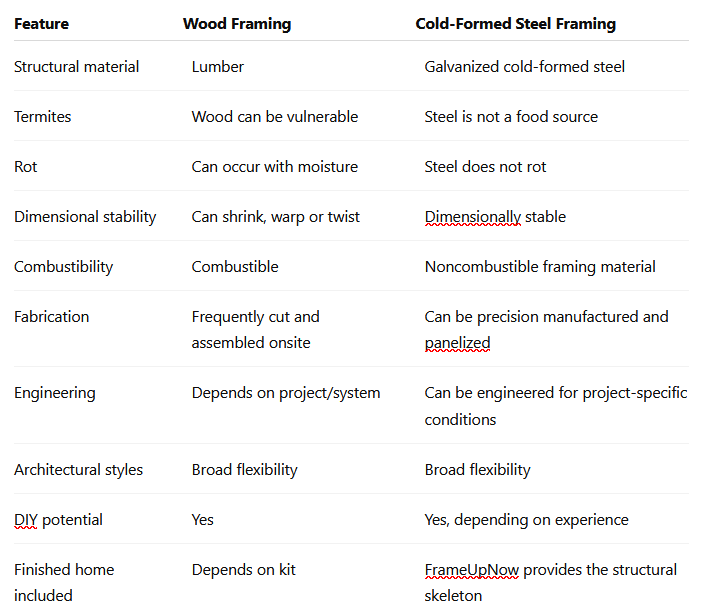
DIY Steel vs. Wood Home Kits: Quick Comparison
Is a DIY Steel Frame Home Kit Right for You?
A DIY steel frame home kit may be a good choice for an owner-builder who wants greater involvement in construction while starting with an engineered structural system.
Cold-formed steel is particularly worth considering if your priorities include:
- Precision-manufactured framing
- Dimensional stability
- Resistance to termites and rot
- Noncombustible structural framing
- Project-specific engineering
- Flexible architectural design
- DIY, hybrid or contractor-managed construction options
It is still important to realistically evaluate your construction experience, available time, local building requirements and which portions of the project should be handled by licensed or experienced professionals.
Build the Structure. Finish It Your Way.
A FrameUpNow home kit is intentionally focused on the structural skeleton.
The goal is to provide an engineered cold-formed steel structure and the information needed to help move the project from plans to assembly.
From there, you decide how the finished home should look, how involved you want to be in construction and where professional trades make the most sense.
Start with an engineered structure. Choose your construction path. Finish the home your way.
Explore FrameUpNow Frames & Plans, learn more about DIY steel frame construction, or use the FrameUpNow Cost Estimator to begin evaluating your project.