
The Julian Home Study
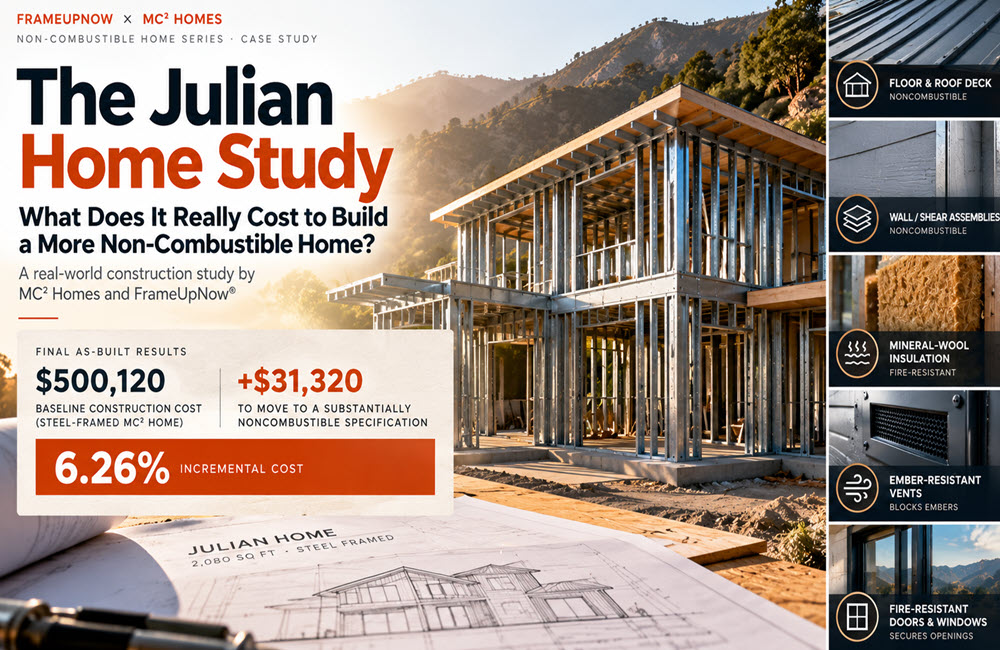
What Does It Really Cost to Build a More Non-Combustible Home?
A real-world construction study by MC² Homes and FrameUpNow®
FINAL RESULTS — The cost figures below are the completed, as-built numbers from the actual Julian Home construction — steel framing held constant, every other major component priced standard versus wildfire-resilient.
There is a growing national conversation about building homes that are better prepared for wildfire.
There is much less conversation about a very practical question:
What does it actually cost?
We decided to find out.
MC² Homes is currently constructing a home that we will call the Julian Home to protect the identity of the homeowner.
The house is real. The construction is real. The costs are real.
And because MC² Homes already builds with cold-formed steel, this is not a wood-versus-steel study.
We are holding the steel framing constant. Instead, we asked a different question:
WHAT WOULD IT COST TO TAKE AN ACTUAL MC² STEEL-FRAMED HOME AND MAKE THE OTHER MAJOR COMPONENTS SUBSTANTIALLY MORE NON-COMBUSTIBLE AND WILDFIRE RESILIENT?
The answer surprised us.
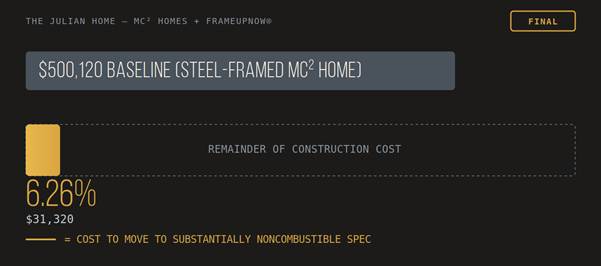
The incremental cost was approximately 6.26%.
On a baseline construction cost of $500,120, the additional cost of the non-combustible/wildfire-resilient specification was approximately $31,320.
That is the Julian number.
But the number is only the beginning of the story.
WHY MC² STARTS WITH STEEL
MC² Homes does not build a wood-framed version of its houses and then offer steel as an alternative.
Steel is the MC² structural system.
The company believes that the economics of steel should be considered over the life of the house, not simply by comparing the initial framing package.
MC² reports that through construction and approximately the first 18 months following completion, it has experienced zero to minimal warranty issues attributable to the twisting, shrinking and warping associated with wood framing.
That is an MC² operating observation—not a controlled scientific comparison—and we are not attempting to prove the economics of steel versus wood in this study.
For the Julian Home, the question is simpler:
STEEL IS ALREADY THERE.
So the steel frame is not an incremental wildfire expense.
INCREMENTAL STEEL COST: $0
That makes the Julian Study different from a conventional wood-to-steel comparison.
THE JULIAN HOME
The Julian Home is approximately 2,080 square feet, two stories, and is being constructed by MC² Homes.
The baseline construction cost used for this study is approximately $500,120.
The house is framed with cold-formed steel.
We then looked at the building component by component.
The objective was not to make the house "fireproof." That would be an irresponsible claim.
The objective was to reduce combustible fuel and reduce the pathways through which wildfire can ignite the home.
WHAT WE CHANGED
The Julian Study examined the major components of a substantially non-combustible/wildfire-resilient home.
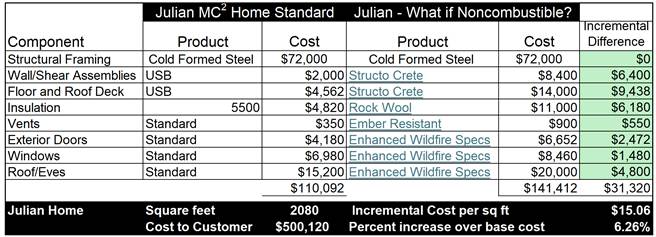
Final as-built component pricing from the completed Julian Home construction.
THE INTERESTING PART WASN'T THE TOTAL
At first glance, $31,320 sounds like a significant amount of money.
It is.
But the more interesting question is:
WHERE DID THE MONEY GO?
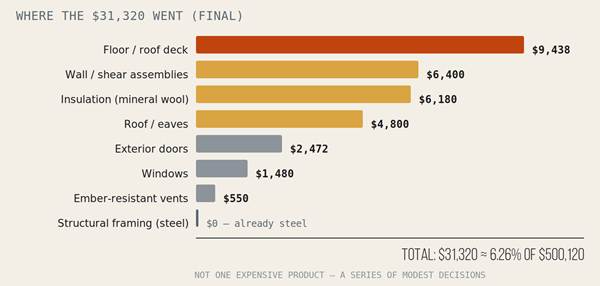
Component-by-component breakdown of the final $31,320 increment, largest to smallest.
The answer was not one enormous expense.
It was a collection of relatively modest decisions.
The largest incremental cost was the floor and roof deck. The second-largest was the noncombustible wall/shear assembly, closely followed by mineral-wool insulation. The roof and eave system and exterior doors made up the next tier, and ember-resistant vents were comparatively inexpensive.
In other words:
THE NON-COMBUSTIBLE HOME WAS NOT CREATED BY ONE EXPENSIVE PRODUCT. IT WAS CREATED BY A SERIES OF DECISIONS.
THE $550 QUESTION
One of the most interesting findings was the relatively small incremental cost of ember-resistant ventilation.
A wildfire does not have to touch a house to ignite it. Wind-driven embers can enter through vulnerable openings.
So the question becomes:
IF EMBER-RESISTANT VENTS COST APPROXIMATELY $550 MORE FOR THE ENTIRE HOUSE, IS THAT A WORTHWHILE INVESTMENT?
That is not a question for the builder alone to answer. It is a question for the homeowner, insurer and ultimately the market.
But it illustrates something important about the Julian Study:
Some wildfire-resilience decisions may be surprisingly inexpensive when incorporated during new construction.
THE $6,180 QUESTION
Mineral-wool insulation added approximately $6,180 in the completed Julian Home.
That is not insignificant.
But consider what the change accomplishes.
The insulation becomes another component of the building system that does not contribute combustible fuel in the same manner as conventional combustible insulation.
It doesn't make the wall fireproof. It doesn't guarantee survival.
But it moves another component of the house toward the non-combustible objective. Again:
THE ENTIRE ASSEMBLY MATTERS.
THE WINDOW QUESTION
Windows represented one of the larger individual upgrades.
The reason is straightforward. Windows are vulnerable to radiant heat, flames and embers.
The Julian Study therefore compared the standard MC² window specification with an enhanced wildfire-performance alternative.
The incremental cost in the completed Julian Home was $1,480 — approximately 0.3% of the total construction cost.
This is where the economics become interesting. A relatively small percentage of the total construction budget can be directed toward improving a known vulnerability.
THE ROOF QUESTION
The roof is one of the most important components of wildfire resilience.
The Julian Study therefore considered the complete roof system—not simply the roof covering. We examined: roof covering, roof deck, eaves, soffits, and vulnerable penetrations.
The final incremental cost was $4,800.
Again, the objective is not to claim that the roof cannot burn. The objective is to reduce the likelihood that embers or radiant heat turn the roof into an ignition point.
THE FIVE-FOOT QUESTION
Perhaps the most overlooked component is the five feet immediately surrounding the home.
IBHS refers to this as Zone 0, and its wildfire research has shown the importance of this area in reducing home ignition.
The Julian Study's component-level cost data didn't isolate Zone 0 site work as its own budget line — it's typically bundled into general site and landscaping costs. That's worth breaking out separately in a future phase of this study, since IBHS research suggests this area affects ignition risk out of proportion to whatever it costs.
The lesson? The most important wildfire-resilience improvement is not necessarily the most expensive.
WHAT DOES 6.26% BUY?
This is where we need to be careful.
The Julian Study does not prove that spending 6.26% more guarantees survival. It does not prove that insurance premiums will be 5%, 10% or 40% lower. It does not prove that the home is fireproof.
It does something more useful.
It establishes a real construction baseline.
For approximately 6.26% additional construction cost, the builder can incorporate a substantially different collection of materials and assemblies.
That is a number that homeowners, developers and insurers can discuss.
HOW DOES THIS COMPARE WITH EXISTING RESEARCH?
There is an important outside benchmark.
IBHS and Headwaters Economics conducted a 2025 study of a representative 1,750-square-foot home in Altadena. They estimated approximately $500,000 in construction cost and found that moving the home to the IBHS Wildfire Prepared Home Plus standard added approximately $15,000, or about 3%.
The Julian Study is different.
The IBHS/Headwaters study examined specific wildfire-resistant construction improvements. The Julian Study asks:
WHAT WOULD IT COST TO MOVE AN ALREADY-STEEL-FRAMED MC² HOUSE SUBSTANTIALLY FARTHER TOWARD A NON-COMBUSTIBLE BUILDING SYSTEM?
The results therefore should not be presented as competing studies. They are different measurements answering related questions.
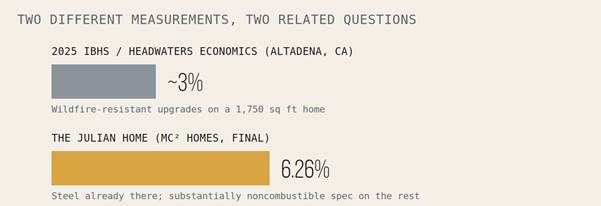
And with the actual Julian number now in at 6.26%, that is an intriguing result:
THE COST OF MOVING FROM CONVENTIONAL CONSTRUCTION TOWARD SUBSTANTIALLY NON-COMBUSTIBLE CONSTRUCTION MAY BE MEASURED IN SINGLE-DIGIT PERCENTAGES RATHER THAN TENS OF PERCENT.
The actual numbers back it up.
AND THEN THERE IS INSURANCE
This is where the Julian Study becomes much more interesting.
The study does not assign an insurance savings to the home.
That would require an actual insurance carrier to evaluate the completed property, its location, its wildfire exposure and the recognized mitigation measures.
But insurance markets are already beginning to recognize wildfire mitigation.
California's Safer from Wildfires program requires participating insurers to provide discounts for qualifying mitigation measures, and the state reports discounts ranging from 4% to 40%, depending on risk and mitigation.
That does not mean the Julian homeowner will receive a 40% discount.
It means something more fundamental:
THE INSURANCE INDUSTRY IS BEGINNING TO PUT AN ECONOMIC VALUE ON MITIGATION.
That creates an intriguing possibility. What if the additional construction cost is partly offset by insurance? What if the benefit is not a lower premium but continued access to insurance? What if a more resilient home has greater appeal to a future buyer?
Those questions remain open. But now there is a construction number against which they can be measured.
THE REAL ECONOMIC QUESTION
Suppose the additional cost really is 6.26%.
Would you spend 6.26% more to substantially reduce combustible materials and wildfire ignition pathways?
Perhaps the answer is yes. Perhaps it is no.
But compare that 6.26% with the consequences of catastrophic loss. A wildfire can destroy:
● 100% of the house.
● 100% of its contents.
● Years of accumulated equity.
● The neighborhood around it.
The question is therefore not:
"DOES WILDFIRE-RESILIENT CONSTRUCTION COST MORE?"
Of course it does.
The better question is:
"HOW MUCH DOES IT COST TO MATERIALLY REDUCE THE RISK—AND WHAT IS THAT RISK WORTH?"
THE DEVELOPER'S OPPORTUNITY
The Julian Home is one house. But imagine 200 Julian Homes.
If the same principles were incorporated throughout an entire subdivision, the conversation changes. The developer could potentially create:
● More noncombustible homes
● Fewer combustible connective fuels
● Noncombustible Zone 0 around each home
● Ember-resistant vents
● Wildfire-appropriate roofs
● Better protected openings
● A neighborhood designed to reduce structure-to-structure fire spread
Now the community itself becomes part of the mitigation strategy.
And that brings us back to the central idea of this series:
A SUBDIVISION CAN EITHER CREATE PATHWAYS FOR FIRE—OR INTERRUPT THEM.
WHAT WE LEARNED FROM JULIAN
The Julian Home Study is deliberately modest.
It is one house. It is one set of plans. It is one builder. It is one set of construction prices.
It is not a universal cost model.
But it demonstrates something important:
WE CAN MEASURE THIS.
We don't have to guess whether noncombustible construction costs 5%. We don't have to repeat somebody else's estimate.
We can take a real house. We can price the alternatives. We can calculate the difference.
And then we can ask the insurance industry, the development industry and the homeowner:
IS THE ADDITIONAL INVESTMENT WORTH IT?
FROM 6.26% TO A REAL NUMBER
We began this project with a hypothesis:
MAYBE A NON-COMBUSTIBLE HOME COSTS APPROXIMATELY 5% MORE.
The Julian Home gives us the opportunity to replace the hypothesis with evidence.
The final number is 6.26% — and that's what we're reporting.
The number is not the objective.
Understanding the number is.
Because if we are going to ask America to build differently for wildfire, builders should know what differently costs. Homeowners should know. Developers should know. And eventually, insurers should know.
THE NEXT GENERATION OF HOMES
The American home is changing.
Lots are becoming smaller. Communities are becoming denser. More homes are being built in areas exposed to wildfire.
At the same time, insurance is becoming a more important component of housing affordability.
That creates an opportunity.
We can continue building homes the way we have always built them and hope the economics of wildfire don't catch up with us.
Or we can begin asking a different question:
WHAT IF THE NEXT GENERATION OF HOMES WERE DESIGNED TO CONTAIN LESS COMBUSTIBLE FUEL FROM THE BEGINNING?
The Julian Home is one attempt to put a number on that idea.
And perhaps that is where the conversation should begin.
DON'T GUESS. MEASURE IT.