
Intellisteel and FrameUpNow: The Cold-Formed Steel Industry's Two Bookends
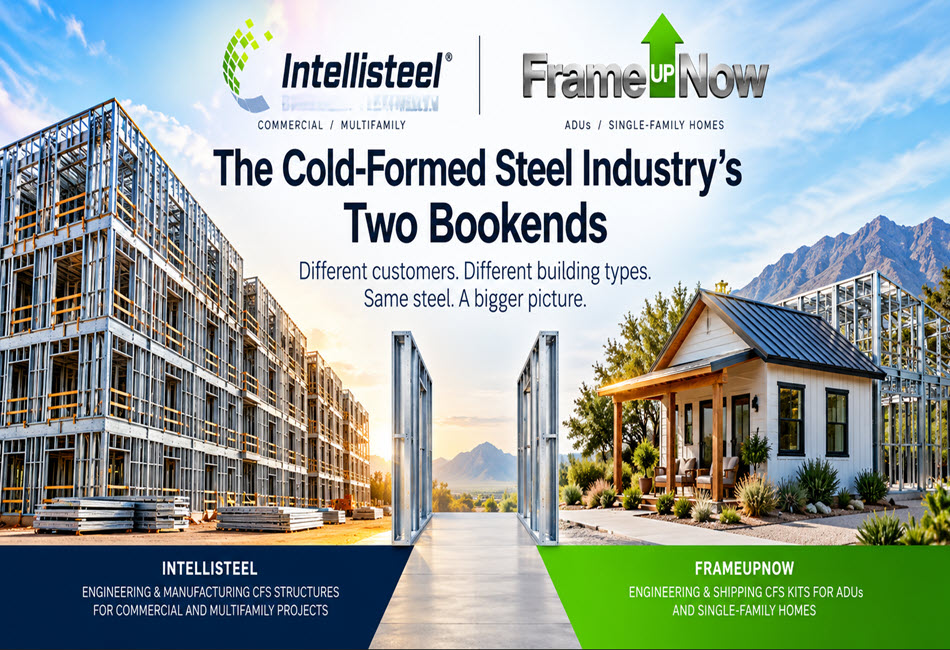
Quick Answer: Intellisteel and FrameUpNow sit at opposite ends of the cold-formed steel (CFS) framing industry — Intellisteel engineers and manufactures CFS structures for low- to mid-rise commercial and multifamily buildings, while FrameUpNow does the same for ADUs and single-family homes. Between the two, they cover nearly every scale of CFS construction, and a growing number of real projects, especially build-to-rent communities, need both at once.
Cold-formed steel (CFS) framing has spent the last decade proving itself project by project — a straighter wall here, a faster schedule there, a wood-to-steel conversion that penciled out cheaper than anyone expected. Two companies now sit at opposite ends of that market, each dominant in its lane: Intellisteel, out of Florida and Texas, engineering and manufacturing CFS structures for low- to mid-rise commercial and multifamily work — apartments, hotels, dormitories, senior living, medical facilities. And FrameUpNow, out of Tucson, Arizona, doing the same for ADUs and single-family homes, manufacturing in the desert and shipping steel skeletons to the edges of the lower 48.
Different customers, different building types, same underlying thesis: steel beats wood on precision, speed, and increasingly, on cost. Put them together and you don't get overlap — you get the two bookends of the CFS framing shelf, with almost every other building type still sitting in the gap between them.
What does Intellisteel do in the cold-formed steel industry?
Intellisteel describes itself as an engineer and manufacturer of cold-formed steel structures, offering both off-site modular or panelized construction and rapidly deployed on-site mobile CFS factories. That mobile-factory model is the company's signature: rather than trucking finished panels cross-country, Intellisteel can bring the manufacturing line to the job site, cutting logistics risk and eliminating the wait for corrected material when something doesn't fit.
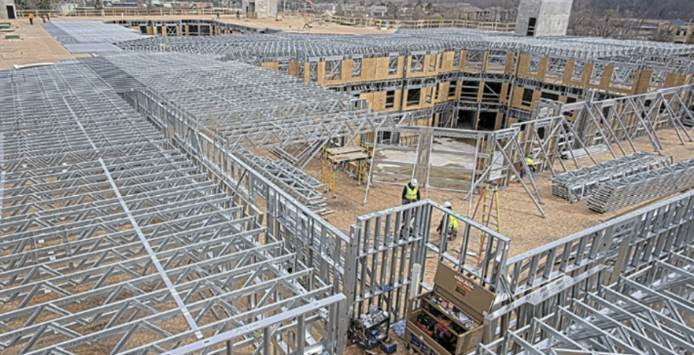
The customer base is squarely commercial and multifamily. Intellisteel's own materials describe the product as well suited to student housing, multi-family residences, medical facilities and hospitals, hotels, senior and assisted living, government, military, modular, and disaster-relief construction — the low-to-mid-rise institutional and hospitality work that general contractors build in volume and that has been almost entirely wood-framed until recently. The company has been converting projects that were originally permitted in wood, including a Brighton, Michigan luxury apartment development, The Vista at Brighton, which Intellisteel transitioned from wood to steel framing using FRAMECAD technology, speeding up the framing schedule and lowering costs.
The scale is real. Intellisteel is headquartered in Groveland, Florida, with a Texas facility in San Marcos and a Michigan facility coming online by the end of 2025, and reports more than $234 million in secured backlog with contracts spanning 21 states through 2028. On the numbers side, the company's pitch is 3x faster build times and 25%-plus cost savings compared with traditional wood or concrete construction.
What does FrameUpNow do in the cold-formed steel industry?
FrameUpNow occupies the other end of the shelf: ADUs, tiny homes, barndominiums, garages and single-family homes. Where Intellisteel sells engineering and mobile manufacturing capacity to general contractors on large institutional jobs, FrameUpNow sells a defined, ready-to-ship product to homeowners, builders, and increasingly build-to-rent developers — steel wall panels, girders, joists, trusses, and beams, engineered to International Building Code standards with Building Information Modeling used to generate exact material quantities before anyone breaks ground.
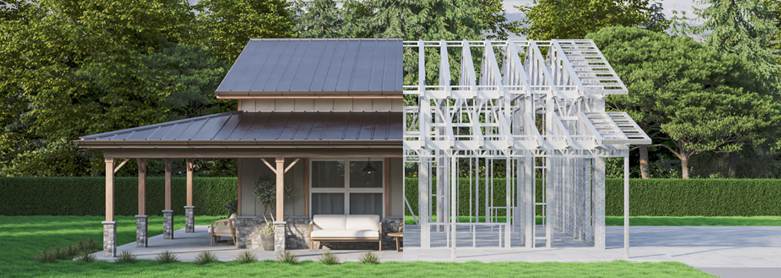
The company's library reflects the residential focus: hundreds of build-ready home designs organized by architectural style and by the Southern California jurisdictions they're permitted in, plus a feeder site, ADUplans.com, that catalogs thousands of permit-ready ADU plans nationally. Kits ship from Arizona to the limits of the lower 48, and the whole approach — DIY-friendly assembly, published material lists, no specialized welding equipment required — is built for a very different buyer than Intellisteel's general contractors: a homeowner, a small builder, or a BTR developer assembling dozens of small units rather than one large structure.
Who else operates in the cold-formed steel framing industry?
Intellisteel and FrameUpNow don't operate in a vacuum, and naming the rest of the field is part of what makes the bookends comparison credible rather than self-serving. The CFS industry has several distinct layers, and the two companies occupy a narrower one than it might first appear:
• Component and coil manufacturers: Large suppliers such as ClarkDietrich, one of the largest cold-formed steel framing manufacturers in the world with 15 plants across the U.S., and MarinoWARE produce the raw studs, track, and connectors that fabricators and contractors buy off the shelf. They supply material into the industry rather than engineering and shipping complete building skeletons the way Intellisteel and FrameUpNow do.
• Engineering and detailing technology: FRAMECAD, the software and roll-forming platform Stanley Adwell headed in the Americas before co-founding Intellisteel, underpins the detailing and manufacturing workflow that a large share of the CFS industry — Intellisteel included — builds on.
• On-site mobile manufacturing: Beyond Intellisteel, other companies are experimenting with bringing CFS roll-forming equipment directly to job sites, including on high-profile projects like the Los Angeles-area wildfire rebuild programs. It's a young approach to construction logistics that both validates the mobile-factory model Intellisteel is scaling and underscores how early this segment of the industry still is.
• Standards and advocacy: The Steel Framing Industry Association (SFIA), based in Washington, D.C., is the trade group that sets code-compliance and stud certification standards for the industry and absorbed the Cold-Formed Steel Engineers Institute (CFSEI) in 2023, giving the sector a single technical and advocacy voice.
Set against that landscape, Intellisteel and FrameUpNow stand out as two of the few companies running the full pipeline end to end — from detailing and engineering through manufacturing to a shipped, ready-to-erect structure — rather than supplying material, software, or standards into someone else's process.
Who leads Intellisteel and FrameUpNow?
Stanley Adwell built Intellisteel from the technology side of the industry. Before co-founding the company, he served as Executive Director of the Americas at FRAMECAD, the steel-frame engineering and manufacturing software system that still underpins Intellisteel's factories today. That background shows in how Adwell talks about the company: design-led, manufacturing-process-first, betting that steel will move from a niche alternative to the default choice for commercial framing. He's described his path as one that went through startup struggles and a near-closure before building what he now frames as the largest cold-formed steel framing company in the U.S. — an operator who scaled a technical, capital-intensive manufacturing business through sheer persistence in an unglamorous part of construction. (LinkedIn)
Rodger Ford arrived at CFS framing from a completely different direction: a long career of building and exiting consumer and industrial brands. He founded AlphaGraphics in 1970, growing it into roughly 400 locations across 20 countries by 1988, later co-founded PetsHotel — acquired by PetsMart in 2000 — and spent years leading medical device companies, including artificial-heart maker SynCardia. Ford co-founded FrameUpNow in December 2022 alongside Brad Cooper and architect Bewketu Arifu, bringing the same instinct that built AlphaGraphics into a global franchise: take a product with real underlying advantages and make it accessible, repeatable, and easy for a non-specialist to buy and use. Where Adwell's career is defined by depth in one industry, Ford's is defined by breadth across several — and a habit of finding the moment when a good idea is ready to scale. (Bio)
What is the unique symbiotic relationship between Intellisteel and FrameUpNow?
Most industry comparisons stop at “complementary market segments.” The more specific point is that real projects increasingly need both scales of CFS building on the same job site — not as a hypothetical merger benefit, but as an actual sourcing problem developers already have:
• One site, two building scales. A build-to-rent cottage court or scattered-site rental community typically pairs dozens of small, repeatable detached units with one larger shared structure — a clubhouse, leasing office, or amenity building. That split maps almost exactly onto FrameUpNow's high-volume residential kits and Intellisteel's institutional-scale engineering. Today, a developer sources those two structures from two unrelated vendors; combined, one relationship could quote the whole site.
• Shared macro tailwinds, no shared customer. Wood price volatility, skilled-labor shortages, insurance and wildfire-code pressure, and a construction industry under pressure to build faster all push both companies' customers toward steel at the same time, without either company competing for the other's buyer.
• A detailing and engineering feedback loop. FrameUpNow's volume in residential-scale detailing surfaces jurisdiction-specific code and connection patterns across hundreds of small projects; Intellisteel's institutional engineering carries the load-case rigor of large multi-unit structures. A combined technical bench could move findings in both directions rather than each company re-learning them independently.
• Complementary manufacturing footprints. Intellisteel's on-site mobile factories are built for large, one-off institutional jobs where bringing the line to the site saves logistics cost. FrameUpNow's fixed Arizona facility and nationwide shipping model is built for smaller, repeatable kits where standardization is the advantage. Together, the manufacturing and delivery map runs Florida–Texas–Michigan and Arizona—covering the country from multiple regional hubs rather than one.
That's the difference between “two companies that don't compete” and “two companies whose combined offering a customer actually needs on one job.” The bookends metaphor holds up because the gap between them isn't empty shelf space — it's demand that already exists.
Why does the combination work?
Lay the two businesses side by side and the fit is less “merger” than “matched set”:
• Building type: Intellisteel owns low-to-mid rise commercial and multifamily; FrameUpNow owns ADUs and single-family. Almost nothing overlaps, and almost nothing in the CFS market falls outside either category.
• Manufacturing model: Intellisteel's factories are built for large, one-off institutional jobs where bringing the line to the site saves logistics cost. FrameUpNow's fixed Arizona facility and nationwide shipping model is built for smaller, repeatable kits where standardization is the advantage. A combined company would have both playbooks available for whichever job fits.
• Geography: Intellisteel's footprint runs Florida–Texas–Michigan; FrameUpNow ships nationally from Arizona. Together, the manufacturing and delivery map covers the country from multiple regional hubs rather than one.
• Demand tailwinds: both companies are riding the same macro forces — wood price volatility, skilled-labor shortages, insurance and wildfire-code pressure, and a construction industry under pressure to build faster and more predictably. A combined company could tell one story to capital markets instead of two smaller ones.
• Leadership: Adwell's deep technical and manufacturing expertise pairs naturally with Ford's track record of scaling accessible, branded products across industries — complementary rather than redundant.
The Bottom Line
Two companies, one framing material, zero overlap in customer, and a shared bet that cold-formed steel is where residential and commercial construction is headed next. That's what makes bookends useful: they don't compete for the same space on the shelf. They define the space between them — and increasingly, real projects need both ends at once. That's what makes Intellisteel and FrameUpNow more than adjacent; it makes them symbiotic.
Frequently Asked Questions
What is cold-formed steel (CFS) framing?
Cold-formed steel framing uses thin-gauge steel components — studs, joists, trusses, and panels — roll-formed at room temperature rather than heat-forged, then assembled into a building's structural skeleton. It's engineered to International Building Code standards and increasingly replaces wood in both commercial and residential construction for its precision, speed, and resistance to fire, pests, and moisture.
What's the difference between Intellisteel and FrameUpNow?
Intellisteel engineers and manufactures CFS structures for general contractors building low- to mid-rise commercial and multifamily projects — apartments, hotels, dormitories, senior living. FrameUpNow engineers and ships CFS kits for ADUs, tiny homes, and single-family houses, selling directly to homeowners, builders, and build-to-rent developers.
Could Intellisteel and FrameUpNow combine into one company?
Nothing has been announced. But the two companies' building types, manufacturing models, and geographic footprints have almost no overlap, which is why they're described as “bookends” of the CFS framing industry — a combination would let one company quote both ends of nearly any CFS project.
What other companies operate in the cold-formed steel framing industry?
The industry includes large component manufacturers like ClarkDietrich and MarinoWARE, which supply steel studs and framing components to fabricators nationwide; FRAMECAD, whose engineering and roll-forming software underpins many CFS manufacturers' detailing process; and the Steel Framing Industry Association (SFIA), the Washington, D.C.-based trade group that sets code-compliance and certification standards for the industry.
Why would a build-to-rent developer need both a large CFS building and many small CFS units on one project?
A typical build-to-rent or cottage-court community includes one larger shared structure — a clubhouse, leasing office, or amenity building — alongside dozens of small, repeatable detached units. That split mirrors Intellisteel's institutional-scale engineering and FrameUpNow's high-volume residential kits, so a single project can draw on both companies instead of sourcing two unrelated vendors.
Who leads Intellisteel and FrameUpNow?
Stanley Adwell co-founded Intellisteel after serving as Executive Director of the Americas at FRAMECAD, the steel-detailing software platform. Rodger Ford co-founded FrameUpNow in December 2022 after a career building and exiting consumer and industrial brands, including AlphaGraphics and PetsHotel.
Does switching from wood to steel framing change a project's permitting or engineering timeline?
No — a design's permit-ready status doesn't change when the framing material switches from wood to cold-formed steel; FrameUpNow's kits are engineered to match the code requirements the original wood-framed design was permitted under.
How fast can each company deliver a CFS structure?
FrameUpNow ships ADU and home framing kits within three days of order from its Arizona facility. Intellisteel, using on-site mobile factories and its Florida, Texas, and Michigan facilities, points to roughly 3x faster build times than traditional wood or concrete construction on its commercial and multifamily projects.