

Steel, sweat and a secret sauce: FrameUpNow - finding industrial success in Benson
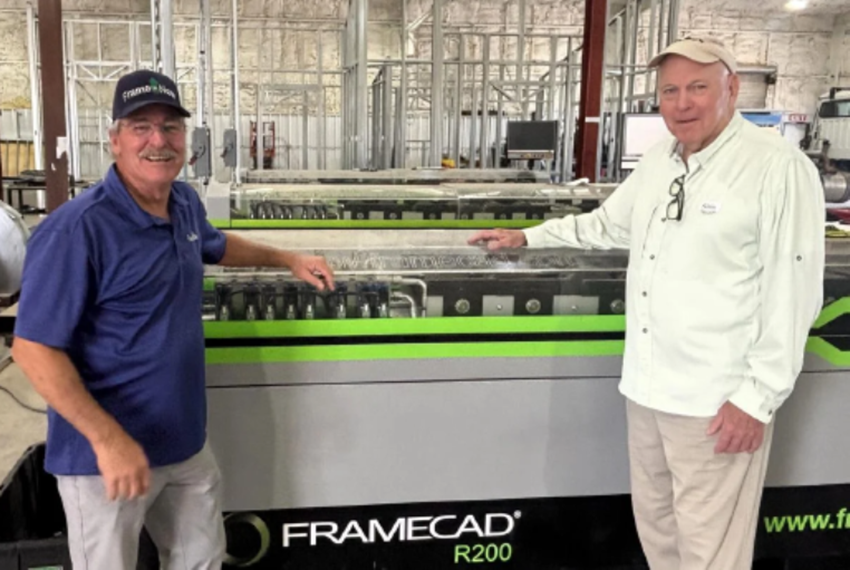
FrameUpNow’s founders regret losing would-be neighbor ADI, but still see a future for manufacturing in Benson.
By Matt Hickman matt.hickman@myheraldreview.com
Quick Takeaways
· Steel homes built near Benson: FrameUpNow has produced framing packages for about 65 homes using its proprietary manufacturing process.
· California rebuilding opportunities: The company supplies noncombustible steel framing for homes in communities recovering from the 2025 wildfires.
· Expansion plans: FrameUpNow hopes to grow from five to 10 employees to about 30, while its founders remain optimistic about Benson's business climate.
BENSON — The machine made it look easy.
Rodger Ford and Brad Cooper were at a building show in Orlando, watching equipment turn steel into the pieces of a house. For Cooper, a general contractor with nearly three decades in construction, the possibilities were hard to walk pat.
So they didn’t. Over three days, they returned to the booth five or six times.
“We could hear them say, ‘Here they come again,’” Ford recalled.
They saw a way to build more homes, more efficiently, on land Ford owned in northern Cochise County. They saw precision, speed and a business they could grow.
Then they tried to engineer their first house.
Three months later, they had a much better understanding of what they had bought into.
“Brad and I fell in love,” Ford said. “If we’d fallen in love slowly, we wouldn’t be in this business.”
What followed that infatuation is the foundation of FrameUpNow, a Benson-area manufacturer whose founders say they have produced steel framing packages for about 65 homes since starting roughly four years ago.
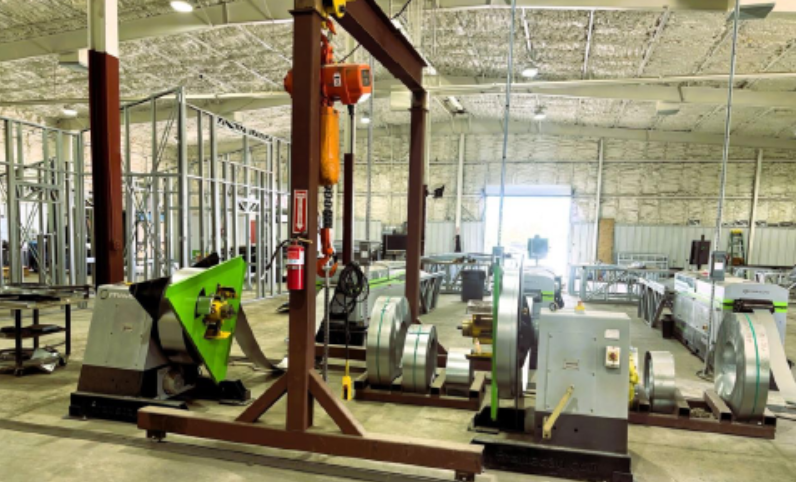
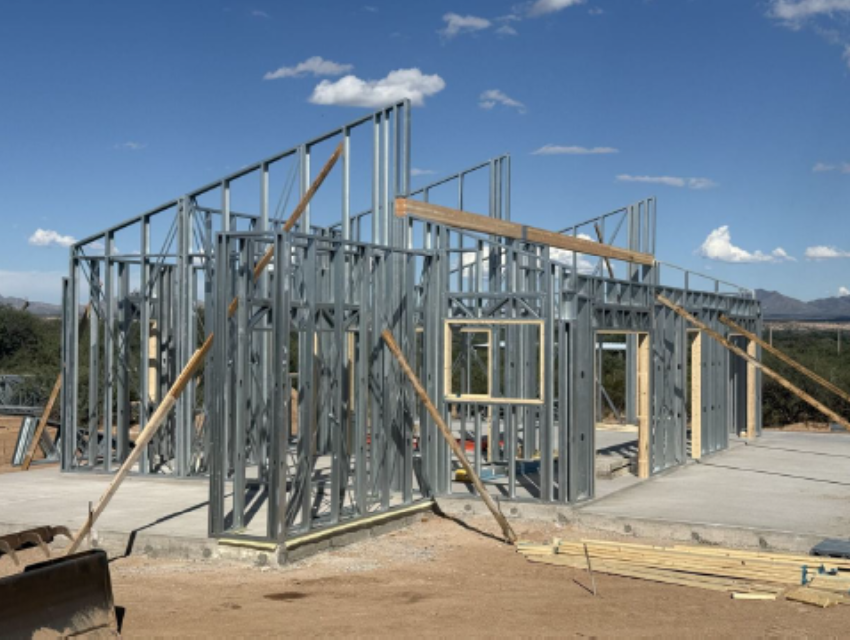
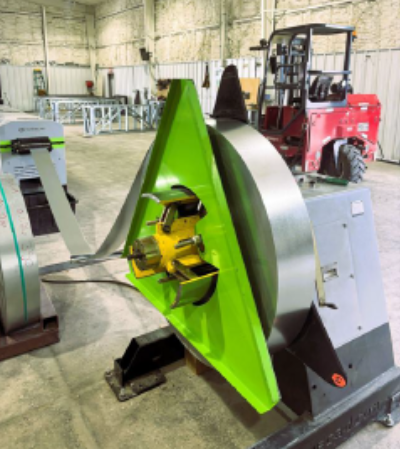
Inside their shop off Pomerene Road, just outside Benson city limits, rolls of galvanized steel become precisely formed components, then wall panels and roof trusses that can be stacked, shipped and assembled on a customer’s foundation.
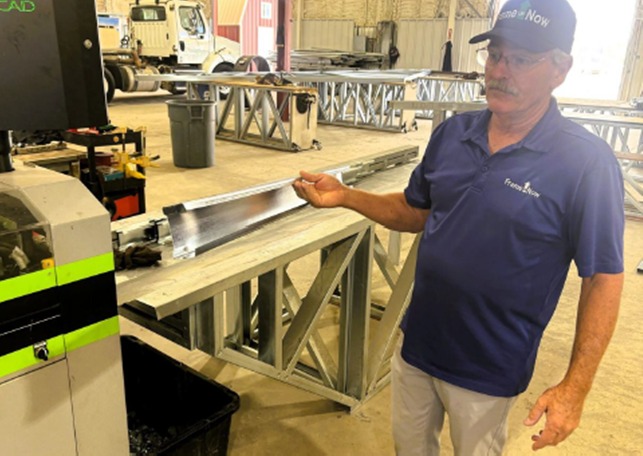
Some are destined for small backyard homes. Others are part of rebuilding efforts in Southern California, where devastating fires have given the question of what a house is made of a different urgency.
The visible product is the skeleton of a building. The harder thing to reproduce, Ford says, is everything they learned before those pieces reached the machine.
“What you’re seeing here looks like we make metal pieces and put them together. That’s what we do,” he said. “But there’s a whole lot of intellectual intelligence applied to this before it ever comes through that machine. That’s the secret sauce.”
Their business also offers a view of Benson’s economic future from people already working on it.
Cooper regrets the departure of Aluminum Dynamics Inc., whose proposed recycling facility nearby became the subject of an extended community fight. Yet when asked whether Benson has welcomed his own company, his answer comes quickly.
“Oh yeah, definitely.”
Three months on the first house
The partnership began with a straightforward alignment of interests.
Ford owned land. Cooper built houses. More home buyers would help both of them.
For Ford, FrameUpNow is the latest turn in a business career that has taken him from printing shops to pet hotels to mechanical hearts. He founded AlphaGraphics in Tucson in 1970 and helped build it into an international printing franchise. He also co-founded Pet’sHotel, later acquired by PetSmart. In medical devices, he served as CEO of artificial-heart manufacturer SynCardia and later co-founded ReliantHeart, a developer of implanted pumps that help failing hearts circulate blood.
In his spare time, Ford, now 83, was a competitive rodeo cowboy, winning buckles in the discipline of team penning.
With Cooper, the immediate interest was building more homes.
“I want Brad to build more on our land so I can sell the land to the customer,” Ford explained. “Brad wants more people to buy the land so he can build more homes.”
Their discovery in Orlando suggested another way to serve those buyers: manufacture the framing off-site, deliver it in panels and reduce the amount of work that had to be figured out on a building lot.
But a machine capable of shaping steel did not arrive with every answer about designing a house around it.
Before the equipment was delivered, they began preparing the facility and working through their first design. They bought a house plan and searched for an engineer who could help translate it into something their machinery could produce.
Ford said an initial list of about 200 engineering candidates was narrowed to 10, then three, before they selected one.
Even then, engineering that first house took three months.
They had to work through the relationship between the drawing, the structural requirements, the machine and the people who ultimately would put the building together. A connection that worked on paper also had to be practical to manufacture and assemble.
Once they found a solution that could be repeated, it became part of their specifications. When something went wrong, they worked backward to determine where it began.
Their original specification book contained about 12 pages, Ford recalled. The accumulated instructions now run to roughly 250 pages, supported by about 6,000 lines of code.
In those pages are decisions about materials, machinery, walls and connections — the growing body of instructions that helps turn a new floor plan into a product the shop knows how to make.
Ford said their database, established procedures and artificial intelligence assistance now allows them to prepare some steel framing designs in about two days.
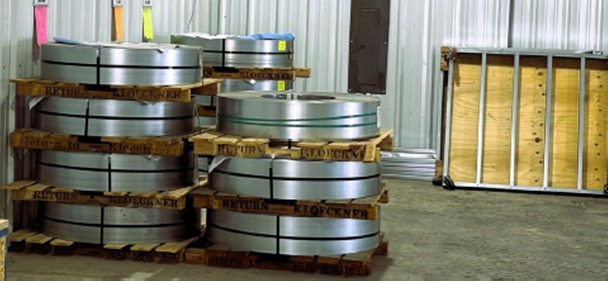
Spools of galvanized steel sourced from Georgia-based Kloeckner stand ready to become house frames.
The three months spent on that first house keep paying their way into the next one.
Protecting the recipe
Every Tuesday at 8 a.m., the learning process gets another appointment.
“We never miss,” Ford said.
The meeting is devoted to the previous week: what happened, what was learned and whether an experience revealed something that needs to become a permanent part of the company’s instructions.
Fixing a single piece allows work to resume. Finding the reason that piece went wrong can prevent the same interruption on the next order.
“Most people who have a problem, say, ‘Who did it?’” Ford said.
Their questions go further.
“Where did it originate? How did it evolve? Where did it show up?”
Then comes the work of changing the underlying process so the solution survives beyond the people who happened to discover it.
That accumulation is what Ford considers proprietary. He regards the combination of specifications, software and manufacturing procedures as the company’s particular advantage, and says competitors getting access to it would be a serious problem.
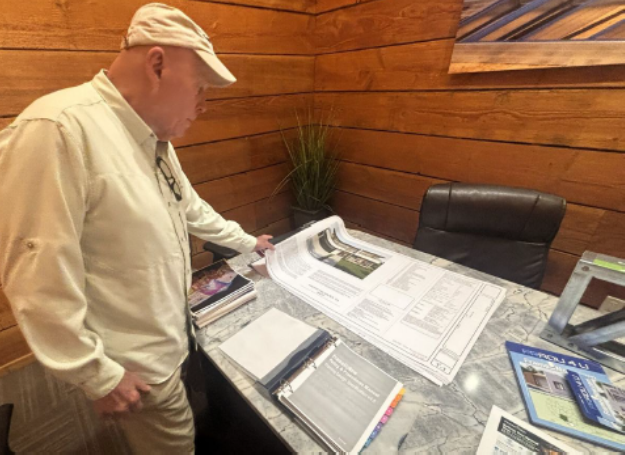
“This book, page by page, records every lesson we learned and how to apply that lesson again to the next home,” he said, flipping through the pages of his sacred text.
Steel framing itself is available to anyone who wants to enter the business. Machines can be purchased. Engineers can be hired. Ford’s contention is that another company would still have to develop the system that makes those resources work together reliably.
Getting the specifications would give a competitor a shortcut through years of that work.
Ford says FrameUpNow declines requests for executable production files because they contain that knowledge.
The founders consider their process unique. Establishing how it compares with every competitor would require a broader examination of the industry, but the distinction they draw is clear: Their investment includes years spent figuring out how to make the equipment productive.
Ford does not want the company reduced to competing over the price of interchangeable metal parts.
“We have to be really careful that we stick to our knitting,” he said. “It’s easy to get out of our lane.”
For all the emphasis on sophisticated engineering, some of the resulting solutions are simple enough to see across the shop.
Panels carry labels to help workers orient them correctly. Assembly videos show customers what comes next. New models that fit inside the facility can be erected there before shipment, checking the design while teaching shop employees how their work functions in the field.
The complicated work is intended to make the next person’s work simpler.
Lessons from overseas
The founders also went looking for answers overseas, including in New Zealand, which Ford credits as the birthplace of steel-framed housing. They visited manufacturers in countries where the building method had a longer foothold, studying how those shops worked and what they could bring home.
Ford pointed to Australia as a place where the need for alternatives to wood was particularly apparent: limited timber and formidable termites.
The overseas manufacturers were generous with their knowledge, he said, welcoming the Arizona visitors as people they could help without creating competition in their own markets.
“They were really gracious to us,” Ford said.
The travel came during FrameUpNow’s first two years, adding another expense to their education. But the lessons followed them home, influencing the equipment and practices inside the Benson-area shop.
“Our shop is full of our round-the-world discoveries,” Ford said.
Their recipe was developed through trial, error and a willingness to see how someone else had solved a problem.
Why change from wood?
Cooper spent most of his building career working with wood. Steel had to persuade him.
Seeing the manufacturing process and examining how the components went together changed his thinking about what he could build.
“Otherwise, I’d still be doing wood to this day,” he said.
The steel used in this kind of construction is formed into relatively light framing members. These become the studs, tracks, trusses and other components that give a home its shape and carry its loads.
Once the house is finished, its structural material does not dictate whether it looks like a conventional neighborhood home, a contemporary residence or a small backyard cottage. The customer still chooses how to finish it.
The practical advantages begin beneath those finishes.
Steel framing is not food for termites and does not undergo the moisture-driven shrinking, twisting and warping associated with lumber. Consistent dimensions can help keep walls straight and openings aligned. Precision manufacturing can reduce cutting and scrap at the building site, and steel scrap is recyclable.
For Cooper, the appeal is also the sequence of work. Panels arrive already assembled, allowing the customer or crew to move into erecting the structure rather than measuring and cutting every member individually on-site.
That does not establish that steel is always the cheaper choice.
Asked to compare the small structure in the shop with a wood version, Cooper said wood materials could cost less, while emphasizing that the steel panels already included assembly work.
A useful comparison has to account for labor, engineering, delivery and the rest of the project, as well as the raw material.
Steel also presents its own design requirements. It conducts heat readily, creating paths for heat to move through an exterior wall. Insulation and wall design must account for that effect, commonly called thermal bridging.
For a builder, considering the switch, familiarity is another hurdle. Crews have to understand the connections, the assembly sequence and how the framing will accommodate the work that follows.
Cooper’s own conversion required seeing the process at work. Now the company faces the task of giving other builders and homebuyers that same exposure.
A market shaped by fire
In Southern California, steel’s most immediate selling point can be expressed without an engineering diagram.
It does not burn. Wood framing can become fuel in a house fire. Steel framing is noncombustible, removing that source of fuel from the structure.
But a home’s protection still depends on the entire assembly, and sufficiently intense heat can weaken steel.
Noncombustible framing does not make a house fireproof.
Combustible siding can expose a house to fire from outside. A window or door can provide another route inside. Insulation, flooring, sheathing and other materials affect what happens next.
Ford described combining steel framing with cement-based sheathing, mineral wool insulation and gypsum drywall as part of an approach intended to reduce combustible material in the building.
The idea is to consider the house as a system, much as the company considers manufacturing as a system. The performance of one component depends on what surrounds it.
That conversation has become part of FrameUpNow’s work in communities recovering from the Southern California fires.
During our interview, Ford displayed plans for a Pacific Palisades home, explaining that the original had burned and that the company’s task was to convert the design from wood framing to steel.
That conversion requires more than changing a material label on a drawing. Connections must be detailed, structural components engineered and the resulting package made understandable to the people reviewing and building it.
The company has also participated in an Altadena rebuild with GA Design Build, according to an account published by FRAMECAD, the manufacturer of the production technology used for the project. That account describes FrameUpNow supplying the engineered steel structural package, including wall panels, trusses and beams, for delivery to the California site.
Altadena and Pacific Palisades represent separate communities affected by the 2025 fires. For the Benson-area shop, both illustrate how a national market can reach its doors: A homeowner hundreds of miles away wants to rebuild, and the structure can begin just east of Benson, Arizona.
Ford said the company’s most productive marketing relationship has been with Southern California-based Design Path Studios, which offers accessory dwelling unit designs.
Customers interested in having those designs produced in steel can be referred to FrameUpNow. That relationship gives the company access to buyers already considering a particular home, rather than requiring it to find every customer from scratch.
The founders see fire-conscious rebuilding as another reason those buyers may consider changing materials.
Insurance is part of Ford’s longer-term thinking, too. He believes construction using fewer combustible materials should make a persuasive case to insurers.
But he does not describe an established, universally available discount customers can simply claim.
“There’s not enough pressure yet on the industry to have a prescription for what I just described,” he said.
For now, the immediate business is designing and delivering the structure. Any insurance savings would require a separate answer from an insurer.
What $18,800 buys
During my visit on Tuesday, a small steel structure stood assembled inside the shop.
Cooper said the framing for the 580-square-foot accessory dwelling unit had gone up
in about an hour with four workers unfamiliar with assembling that structure.
Once checked, it could be taken apart, packaged and shipped. This one was headed to a buyer in Elgin.
The framing package was priced at $18,800.
That figure buys the bones of the home. A foundation, utility connections, roofing, insulation, siding, interior finishes and the work required to install them remain part of the customer’s project.
FrameUpNow also generates a materials shopping list with a registry at Home Depot locations nationwide intended to identify what is needed to complete the building.
Customers can use it to shop for the remaining products and make their own selections.
The company serves contractors, experienced do-it-yourselfers and people between those categories.
Cooper said that middle group represents their main customer type: someone willing to assemble the structure but planning to hire an electrician, plumber or other tradespeople for work beyond their abilities.
“You need to have somebody that has kind of an idea that can read a plan, and then some help just to put it up,” he said.
Their principal market is accessory dwelling units, often called ADUs: smaller homes sharing a lot with an existing residence.
Ford sees an advantage in starting with land someone already owns and potentially near existing utility infrastructure. It can remove some of the expense and uncertainty associated with acquiring and developing another home site.
The remaining project still requires money, decisions and work. FrameUpNow’s proposition is that a more predictable structure and a clearer materials list can make that undertaking easier to manage.
Benson after ADI
At its current pace, FrameUpNow produces framing packages for about 25 homes annually, Ford said. Cooper said the shop employs between five and 10 people.
They envision substantially more production and potentially two shifts with about 30 workers by the end of next year.
Nearby, the much larger investment they once expected to see has fallen away.
ADI announced in June that it would pursue a Mississippi location for its proposed aluminum recycling facility. Its withdrawal followed sustained community opposition and a political upheaval that included the recall of three City Council members. The company cited differences with Arizona Attorney General Kris Mayes and its production timetable in explaining the decision.
For Cooper, it was an opportunity Benson shouldn't have chased away.
“I was disappointed to see how it went down,” he said. “I think we missed the boat.”
He recognizes that other residents reached a different conclusion.
“There’s a lot of people in Benson that see that totally different than I,” Cooper said.
“They won out.”
FrameUpNow’s experience cannot resolve the dispute over ADI. A shop manufacturing steel framing and a facility recycling aluminum present different questions about scale, operations and effects on their surroundings.
There is also a jurisdictional distinction: Cooper said FrameUpNow’s shop sits just outside Benson’s city limits, while ADI would have resided just inside them.
Still, his description of the welcome his company received complicates any sweeping conclusion that Benson has closed its doors to business.
He described the City Council and Chamber of Commerce as accommodating, interested in touring the facility and helpful in promoting the company.
The founders remain optimistic about the area’s economic prospects, pointing to Interstate 10, the workforce and the potential for development spreading east from Tucson.
Their own challenge is to turn that confidence into more orders, more production and, eventually, more jobs.
The equipment is in place. The recipe continues to grow. Every Tuesday morning, they sit down to decide what belongs on the next page.
For Ford, whose career has already ranged from printing franchises to artificial hearts, retirement remains an available option.
“Well, I could,” he said, “but I’m more interested in making a difference.”
Tags
Frameupnow, Benson Arizona, Rodger Ford, Brad Cooper, Steel-framed Homes, Light-gauge Steel Framing, Modular Home Framing, Adu Construction, Cold-formed Steel, Steel Home Construction, Prefabricated Wall Panels, Accessory Dwelling Units, Benson Manufacturing, Cochise County Economic Development, Southern California Wildfire Rebuilding, Pacific Palisades Rebuilding, Altadena Rebuilding, Fire-resistant Construction, Noncombustible Building Materials, Framecad, Design Path Studios, Ga Design Build, Pomerene Road, Aluminum Dynamics Inc. Adi Benson, Benson Business Climate, Arizona Manufacturing Housing, Construction Technology, Proprietary Manufacturing Process, Construction Automation Steel Framing Kits, Workforce Expansion, Alphagraphics Syncardia, Reliantheart, Affordable Housing Construction
Matt Hickman, Managing Editor, Herald/Review